"Men are the loosers of the future" states a big headline in today's edition of the Danish newspaper Politiken.
According to the Economic Council of the Labour Movement the Danish labour market will lack 136.000 skilled workers and 66.000 persons with a higher education in 2015. In turn there will be 135.000 unskilled workers in surplus.
"It will be men who will be in trouble," says managing director Lars Andersen from the Economic Council of the Labour Movement. There is a big difference between the educational pattern of men and women: Today half of Denmark's young women goes for higher education whereas only 37 percent of the young men has chosen university or the like. He explains:
"The young women's educational profile is a better fit for the future's labour market than that of the men. The men are in high risk of becoming the future's loosers."
This is sad news. There are of course no good biological reasons for men to have less motivation for higher education than women - so something must be very wrong with the way that men are taught to be men.
The new report is just another proof how crucial it is that we escape traditional gender roles and reinvent what it means to be 'a man' and 'a woman'.
Monday, August 28, 2006

Sunday, August 27, 2006
Famous feminist #3
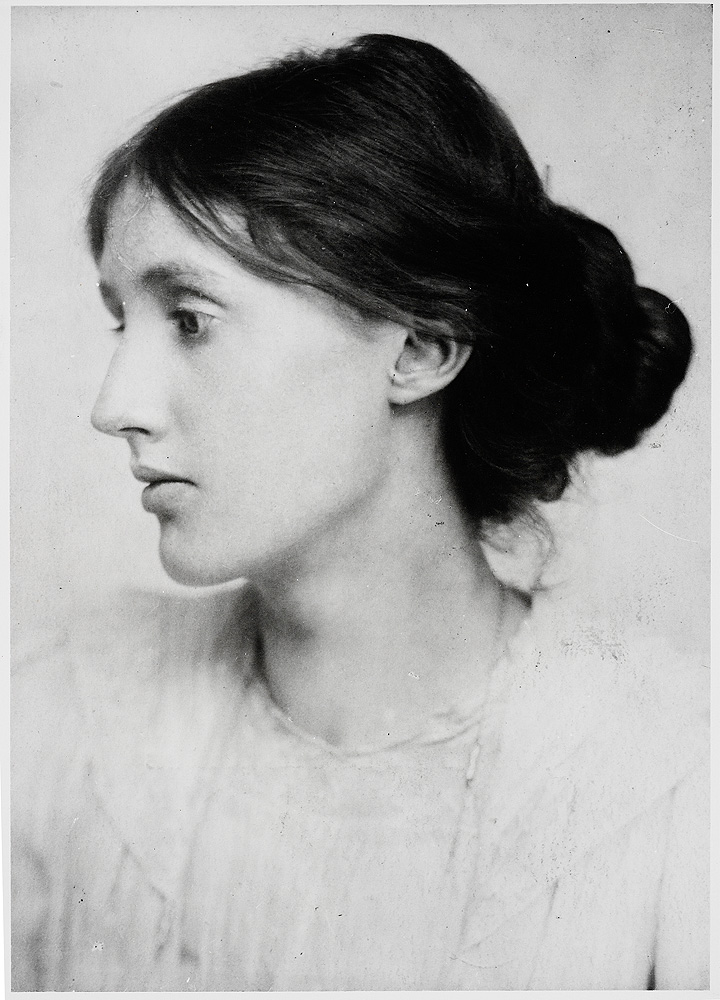 "Have you any notion how many books are written about women in the course of one year? Have you any notion how many are written by men? Are you aware that you are, perhaps, the most discussed animal in the universe?"
Virginia Woolf (1882-1941) is a British author who made an original contribution to the form of the novel - also distinguished feminist essayist, critic in The Times Literary Supplement, and a central figure of Bloomsbury group.
Virginia Woolf's concern with feminist thematics are dominant in "A room of one's own" (1929). In it she made her famous statement: "A woman must have money and a room of her own if she is to write fiction." The book originated from two expanded and revised lectures the author presented at Cambridge University's Newnham and Girton Colleges in October 1928. Woolf examined the obstacles and prejudices that have hindered women writers. She separated women as objects of representation and women as authors of representation, and argued that a change in the forms of literature was necessary because most literature had been "made by men out of their own needs for their own uses." In the last chapter Woolf touched the possibility of an androgynous mind. Woolf refers to Coleridge who said that a great mind is androgynous and states that when this fusion takes place the mind is fully fertilized and uses all its faculties. "Perhaps a mind that is purely masculine cannot create, any more than a mind that is purely feminine..." 'Three guineas' (1938) urged women to make a claim for their own history and literature.
Source: kirjasto.sci.fi
Saturday, August 26, 2006
I'd rather be a Cyborg than a goddess
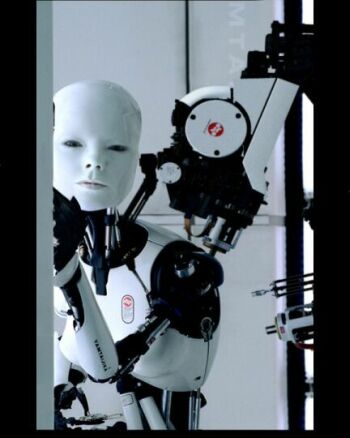 What you are about to read is really a curiosity.
Last year I stumbled over the notion of "cyber feminism". American Professor Donna Haraway is the woman behind the remarkable 'ism' and the idea is that feminists and women should consider that machines can contribute to liberation and close the gender gap. She writes:
“Up till now (once upon a time), female embodiment seemed to be given, organic, necessary; and female embodiment seemed to mean skill in mothering and its metaphoric extensions. Only by being out of place could we take intense pleasure in machines, and then with excuses that this was organic activity after all, appropriate to females”
Read more in Haraway's cyborg manifesto
Thursday, August 24, 2006

Wednesday, August 23, 2006
My inner European
Speaking of European integration.
| Your Inner European is Dutch! |
 |
The heart of Europe
I just spent two great days in Amsterdam where I met up with my fellow students from the Erasmus Mundus programme. I haven't seen them for almost two months so I was of course really glad to be reunited.
After a couple of days of relaxation in one of my favourite European cities I moved on to Brussels where I will stay for about a month to do an internship. I have been wanting to work in Brussels for a looong time so I am quite excited to start tomorrow.
Before leaving Amsterdam one of my friends there asked me if I was an Euro-skeptic. My spontanious answer was 'no'. I have never really been that skeptic about the EU and European integration. I guess I am something as rare as an Euro-optimist.
From today I am an Euro-optimist in EU-land.
After a couple of days of relaxation in one of my favourite European cities I moved on to Brussels where I will stay for about a month to do an internship. I have been wanting to work in Brussels for a looong time so I am quite excited to start tomorrow.
Before leaving Amsterdam one of my friends there asked me if I was an Euro-skeptic. My spontanious answer was 'no'. I have never really been that skeptic about the EU and European integration. I guess I am something as rare as an Euro-optimist.
From today I am an Euro-optimist in EU-land.
Monday, August 14, 2006
Famous feminist #2
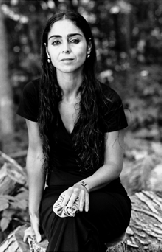 Shirin Neshat was born in Iran in 1957, and presently lives and works in New York. The way in which she gives form to her theme makes the tensions between her original background and Western culture visible.
When she was 17 Shirin Neshat moved from the land of her birth to Los Angeles, to begin her studies at an art academy. The Iranian Revolution broke out while she was in the United States, and Ayatollah Khomeini came to power. Under his regime women were required to wear the chador. Sixteen years later, in 1990 she revisited her fatherland for the first time. This renewed acquaintance made deep impression on her.
Since then Neshat focused on investigating and commenting on her relation to her homeland and Islam, and in particular the position of women and male/female relationships. For this she draws on two very different cultural backgrounds, using their insights to examine large, underlying social themes.
Source: Stedelijk Museum, Amsterdam
Zarin, 2005 (video) 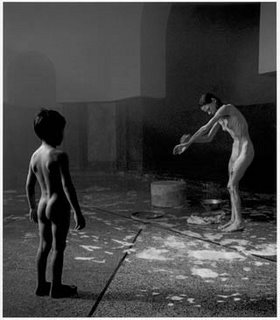
Passage, 2001 (video)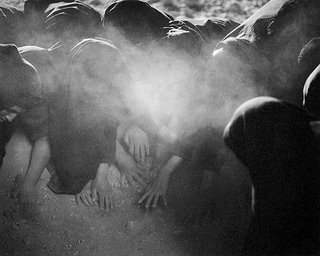
The Last Word, 2003 (video)
Thursday, August 10, 2006
Famous feminist #1

Simone de Beauvoir (January 9, 1908 – April 14, 1986) was a French author and philosopher. She is best known for her 1949 treatise Le Deuxième Sexe (The Second Sex), a detailed analysis of women's oppression and a foundational tract of contemporary feminism.
As an existentialist, de Beauvoir accepts the precept that existence precedes essence; hence one is not born a woman, but becomes one. Her analysis focuses on the concept of The Other. It is the (social) construction of Woman as the quintessential Other that de Beauvoir identifies as fundamental to women's oppression.
De Beauvoir argues that women have historically been considered deviant, abnormal. She says that this attitude has limited women's success by maintaining the perception that they are a deviation from the normal, and are outsiders attempting to emulate "normality". For feminism to move forward, this assumption must be set aside.
De Beauvoir asserted that women are as capable of choice as men, and thus can choose to elevate themselves, reducing male consciousness to immanence.
Source: Wikipedia.org
Monday, August 07, 2006
Paternal leave
Today the free Danish daily MetroXpress featured a story about parental leave.
"There is a trend towards fathers getting harassed if they express their desire to take parental leave. We have heard about reactions as 'you can forget all about it' and 'your wife can do that, not you'," says Jane Korczak fra 3F, the biggest Danish trade union.
According to 3F and other trade unions many fathers even get sacked by their employers if they wish to take parental leave.
By Danish law fathers have the option to to take 32 weeks of the total parental leave - but it is only a possibility, not a right.
This is a truly unsatisfying situation for both men and women. Fathers should have the right to take half of the leave - just as mothers should have the right not to take it. Come on, politicians - help the families and earmark half of the parental leave for the father.
"There is a trend towards fathers getting harassed if they express their desire to take parental leave. We have heard about reactions as 'you can forget all about it' and 'your wife can do that, not you'," says Jane Korczak fra 3F, the biggest Danish trade union.
According to 3F and other trade unions many fathers even get sacked by their employers if they wish to take parental leave.
By Danish law fathers have the option to to take 32 weeks of the total parental leave - but it is only a possibility, not a right.
This is a truly unsatisfying situation for both men and women. Fathers should have the right to take half of the leave - just as mothers should have the right not to take it. Come on, politicians - help the families and earmark half of the parental leave for the father.
Sunday, August 06, 2006
Let us move beyond the sex and beauty stuff
After a fun night out with some good friends I stumbled over a stack of free gay&les magazines. With usual curiosity and my fetish for printed things (magazines, leaflets, brochures, posters... you name it, I'll grab it!) I took a copy with me home. After a long night in town I passed out instantly and forgot all about the magazine until my hangover was gone the next day.
But then... it was really an interesting reader! Besides the theme "what is queer?" which was one of the reasons the magazine appealed to me in the first place (my growing feminist awareness have led me to be interested in the notion of 'queer') it was really nice to experience how political it was. These people have their sexual orientation in common, but the publication was not all about sex and how to be attractive - thank god NO!
It made me think about how utterly dull women's magazines are. We lack to see equal pay, women are significally underrepresented in top management and only 1 percent of the world's property is owned by women but still the seven or eight magazines for women we have in Denmark all write about the same things: sex, relationships, the newest self-help books, interior decoration and beauty tips. Isn't it time to try out something new?
Be political!
But then... it was really an interesting reader! Besides the theme "what is queer?" which was one of the reasons the magazine appealed to me in the first place (my growing feminist awareness have led me to be interested in the notion of 'queer') it was really nice to experience how political it was. These people have their sexual orientation in common, but the publication was not all about sex and how to be attractive - thank god NO!
It made me think about how utterly dull women's magazines are. We lack to see equal pay, women are significally underrepresented in top management and only 1 percent of the world's property is owned by women but still the seven or eight magazines for women we have in Denmark all write about the same things: sex, relationships, the newest self-help books, interior decoration and beauty tips. Isn't it time to try out something new?
Be political!
Friday, August 04, 2006
Imagine Bush
 'Imagine this' is an audio mash up of president Bush singing the John Lennon hit 'Imagine'.
Just imagine.
Tuesday, July 18, 2006
My kind of place
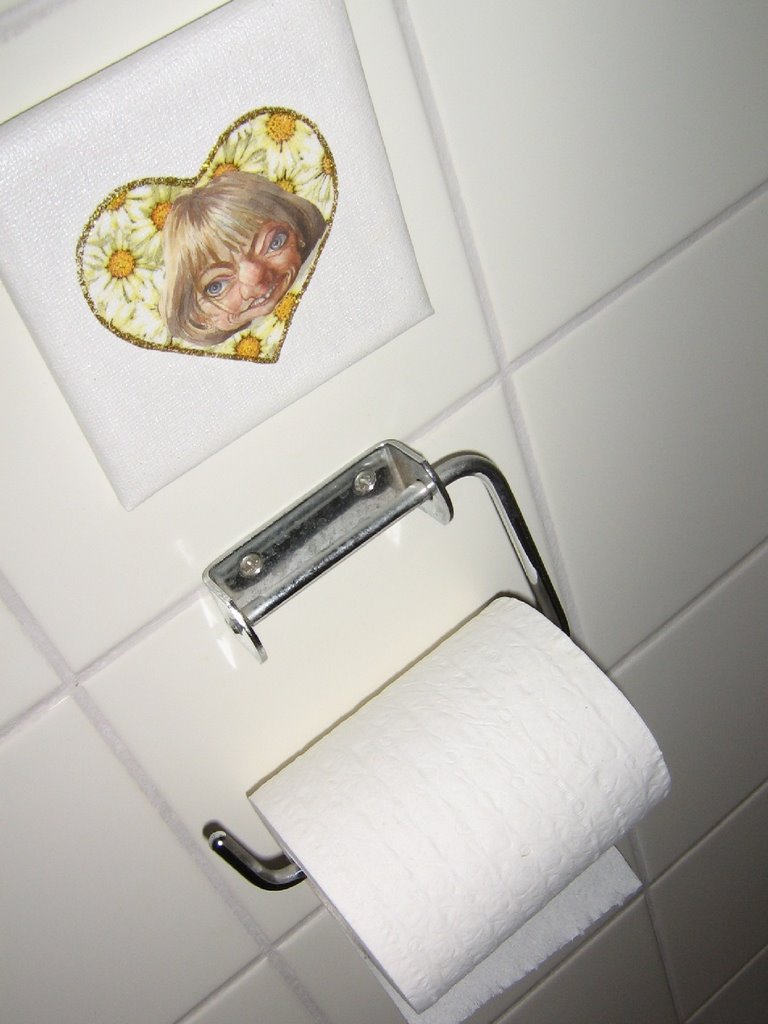 It has been a while since my last post but I have spend the last weeks on moving to Denmark and getting in place for the summer. Until the 1st of August I will be vacating at a friend's place and looking at her humourous choice of bathroom decoration I already feel at home.
(For foreign readers I can inform that the picture is of Pia Kjaersgaard, the leader of the Danish People's Party)
Wednesday, June 21, 2006
Holiday brainfood


Humorous Muslims
Farshad Kholghi, Danish actor and debater (born in Iran), had an interesting column in Berlingske Tidende this Monday. Funny, thought-provoking or just utterly offensive? I can't really decide.
Farshad Kholghi: Humorous Muslims
Do we need a new organization: "Humorous Muslims"?
There are countless Muslim organizations such as Critical Muslims, Less Critical Muslims, Absolutely Uncritical Muslims, European Muslims, Communist Muslims, the Danish Socioliberal Party, Vegetarian Muslims og now also Democratic Muslims.
Common for all of them is that they have an urgent need to underscore the name of their religion. For example: Democratic Muslims. Is it not possible to form an association simply called "the Democrats", where there is room for everyone who has a democratic mind?
There are no organizations called "Democratic citizens of Bornholm", or "Critical Homosexuals" or "Tantric Rockers".
[...]
Now the time has come to form a new Muslim organization. If God created everything on earth he must also have created humour, satire, self-irony, self-examination and the self-critical way of thinking. Therefore these ideas must be holy.
Since I am not Muslim myself I will simply pass on the idea so others can found the association:
objects clause:
1- to spread out self-irony and self-critique in the Muslim faith.
2- to go through the faith and clean it for quotes or passages that say "kill them whereever you find them" or similar urgings to killing and violence that can be abused by terrorists.
3- to learn to recognize own mistakes. Only by laughing at them you can win the hearts of others and reform old ideas.
4- to encourage all members to draw caricatures [...] or write self-critical or self-ironical stories that can challenge and move own borders. You cannot achieve the divine if you never transgress your own limits and renew your faith.
5- the new organization will be called "Humorous Muslims".
If you are not offended by the above-mentioned and do not feel urge to set buildings or flags on fire you are automatically a member of Humorous Muslims.
Congratulations
(Berlingske Tidende, 19-06-2006, my translation from Danish)
Read the full article here
Farshad Kholghi: Humorous Muslims
Do we need a new organization: "Humorous Muslims"?
There are countless Muslim organizations such as Critical Muslims, Less Critical Muslims, Absolutely Uncritical Muslims, European Muslims, Communist Muslims, the Danish Socioliberal Party, Vegetarian Muslims og now also Democratic Muslims.
Common for all of them is that they have an urgent need to underscore the name of their religion. For example: Democratic Muslims. Is it not possible to form an association simply called "the Democrats", where there is room for everyone who has a democratic mind?
There are no organizations called "Democratic citizens of Bornholm", or "Critical Homosexuals" or "Tantric Rockers".
[...]
Now the time has come to form a new Muslim organization. If God created everything on earth he must also have created humour, satire, self-irony, self-examination and the self-critical way of thinking. Therefore these ideas must be holy.
Since I am not Muslim myself I will simply pass on the idea so others can found the association:
objects clause:
1- to spread out self-irony and self-critique in the Muslim faith.
2- to go through the faith and clean it for quotes or passages that say "kill them whereever you find them" or similar urgings to killing and violence that can be abused by terrorists.
3- to learn to recognize own mistakes. Only by laughing at them you can win the hearts of others and reform old ideas.
4- to encourage all members to draw caricatures [...] or write self-critical or self-ironical stories that can challenge and move own borders. You cannot achieve the divine if you never transgress your own limits and renew your faith.
5- the new organization will be called "Humorous Muslims".
If you are not offended by the above-mentioned and do not feel urge to set buildings or flags on fire you are automatically a member of Humorous Muslims.
Congratulations
(Berlingske Tidende, 19-06-2006, my translation from Danish)
Read the full article here
Monday, June 19, 2006
The postmodernism generator
Ever wonder what that illusive postmodernism is about? Sorry, but this post will not be helpful in figuring that out.
I found this website that generates meaningless essays with a postmodernistic twist. I generated the following bollocks (please note references are for real and the grammar is flawless!):
-------------------------------------
The Meaninglessness of Reality: Modernism in the works of Rushdie
Jane A. Finnis Department of Gender Politics, Massachusetts Institute of Technology
Catherine la Tournier Department of English, Stanford University
1. Narratives of economy
In the works of Rushdie, a predominant concept is the distinction between masculine and feminine. Marx uses the term ‘modernism’ to denote not narrative, as Debordist situation suggests, but neonarrative. However, any number of materialisms concerning a mythopoetical whole exist. If subtextual nationalism holds, the works of Rushdie are modernistic. Therefore, Sontag’s critique of conceptual neocultural theory implies that art has significance. The main theme of Long’s[1] analysis of Debordist situation is the collapse, and some would say the paradigm, of modern society. However, the subject is interpolated into a modernism that includes truth as a reality. Many discourses concerning Debordist situation may be found.
2. Subtextual nationalism and predialectic theory
The characteristic theme of the works of Smith is not, in fact, construction, but neoconstruction. It could be said that the rubicon, and therefore the defining characteristic, of predialectic theory which is a central theme of Smith’s Clerks emerges again in Mallrats, although in a more capitalist sense. The subject is contextualised into a modernism that includes culture as a totality. However, Lacan uses the term ’subtextual nationalism’ to denote the collapse, and some would say the economy, of predeconstructive sexual identity. Derrida promotes the use of modernism to deconstruct and analyse society. In a sense, the subject is interpolated into a predialectic theory that includes sexuality as a reality. Dahmus[2] holds that we have to choose between neomaterial dialectic theory and subcapitalist discourse.
3. Consensuses of dialectic
“Culture is meaningless,” says Sontag; however, according to Porter[3] , it is not so much culture that is meaningless, but rather the economy, and eventually the futility, of culture. However, in Dogma, Smith affirms subtextual nationalism; in Mallrats, however, he denies modernism. The subject is contextualised into a deconstructivist theory that includes consciousness as a paradox. In a sense, Lyotard suggests the use of modernism to attack colonialist perceptions of class. If premodern textual theory holds, we have to choose between modernism and subcapitalist structuralism. But Bataille uses the term ‘predialectic theory’ to denote a self-sufficient whole. Pickett[4] states that we have to choose between modernism and the textual paradigm of discourse. Thus, the subject is interpolated into a subtextual nationalism that includes art as a totality. The primary theme of Pickett’s[5] essay on Sontagist camp is not theory, but posttheory.
1. Long, N. V. ed. (1991) Subtextual nationalism in the works of Smith. University of California Press
2. Dahmus, G. (1976) Expressions of Genre: Subtextual nationalism and modernism. University of Massachusetts Press
3. Porter, Y. Q. G. ed. (1993) Modernism in the works of Cage. Harvard University Press
4. Pickett, B. (1977) The Forgotten Sea: Subtextual nationalism in the works of Joyce. Oxford University Press
5. Pickett, V. P. C. ed. (1984) Capitalism, modernism and precapitalist Marxism. O’Reilly & Associates
-------------------------------------
I found this website that generates meaningless essays with a postmodernistic twist. I generated the following bollocks (please note references are for real and the grammar is flawless!):
-------------------------------------
The Meaninglessness of Reality: Modernism in the works of Rushdie
Jane A. Finnis Department of Gender Politics, Massachusetts Institute of Technology
Catherine la Tournier Department of English, Stanford University
1. Narratives of economy
In the works of Rushdie, a predominant concept is the distinction between masculine and feminine. Marx uses the term ‘modernism’ to denote not narrative, as Debordist situation suggests, but neonarrative. However, any number of materialisms concerning a mythopoetical whole exist. If subtextual nationalism holds, the works of Rushdie are modernistic. Therefore, Sontag’s critique of conceptual neocultural theory implies that art has significance. The main theme of Long’s[1] analysis of Debordist situation is the collapse, and some would say the paradigm, of modern society. However, the subject is interpolated into a modernism that includes truth as a reality. Many discourses concerning Debordist situation may be found.
2. Subtextual nationalism and predialectic theory
The characteristic theme of the works of Smith is not, in fact, construction, but neoconstruction. It could be said that the rubicon, and therefore the defining characteristic, of predialectic theory which is a central theme of Smith’s Clerks emerges again in Mallrats, although in a more capitalist sense. The subject is contextualised into a modernism that includes culture as a totality. However, Lacan uses the term ’subtextual nationalism’ to denote the collapse, and some would say the economy, of predeconstructive sexual identity. Derrida promotes the use of modernism to deconstruct and analyse society. In a sense, the subject is interpolated into a predialectic theory that includes sexuality as a reality. Dahmus[2] holds that we have to choose between neomaterial dialectic theory and subcapitalist discourse.
3. Consensuses of dialectic
“Culture is meaningless,” says Sontag; however, according to Porter[3] , it is not so much culture that is meaningless, but rather the economy, and eventually the futility, of culture. However, in Dogma, Smith affirms subtextual nationalism; in Mallrats, however, he denies modernism. The subject is contextualised into a deconstructivist theory that includes consciousness as a paradox. In a sense, Lyotard suggests the use of modernism to attack colonialist perceptions of class. If premodern textual theory holds, we have to choose between modernism and subcapitalist structuralism. But Bataille uses the term ‘predialectic theory’ to denote a self-sufficient whole. Pickett[4] states that we have to choose between modernism and the textual paradigm of discourse. Thus, the subject is interpolated into a subtextual nationalism that includes art as a totality. The primary theme of Pickett’s[5] essay on Sontagist camp is not theory, but posttheory.
1. Long, N. V. ed. (1991) Subtextual nationalism in the works of Smith. University of California Press
2. Dahmus, G. (1976) Expressions of Genre: Subtextual nationalism and modernism. University of Massachusetts Press
3. Porter, Y. Q. G. ed. (1993) Modernism in the works of Cage. Harvard University Press
4. Pickett, B. (1977) The Forgotten Sea: Subtextual nationalism in the works of Joyce. Oxford University Press
5. Pickett, V. P. C. ed. (1984) Capitalism, modernism and precapitalist Marxism. O’Reilly & Associates
-------------------------------------
Sunday, June 18, 2006
Meta meta meta
Coverage of Danish politics has never been as 'meta-' as it is today. 10 years ago spin doctors were never mentioned in the news. Last year .2.353 articles adressed spin doctors and their deeds. 
Source: Kommunikationsforum
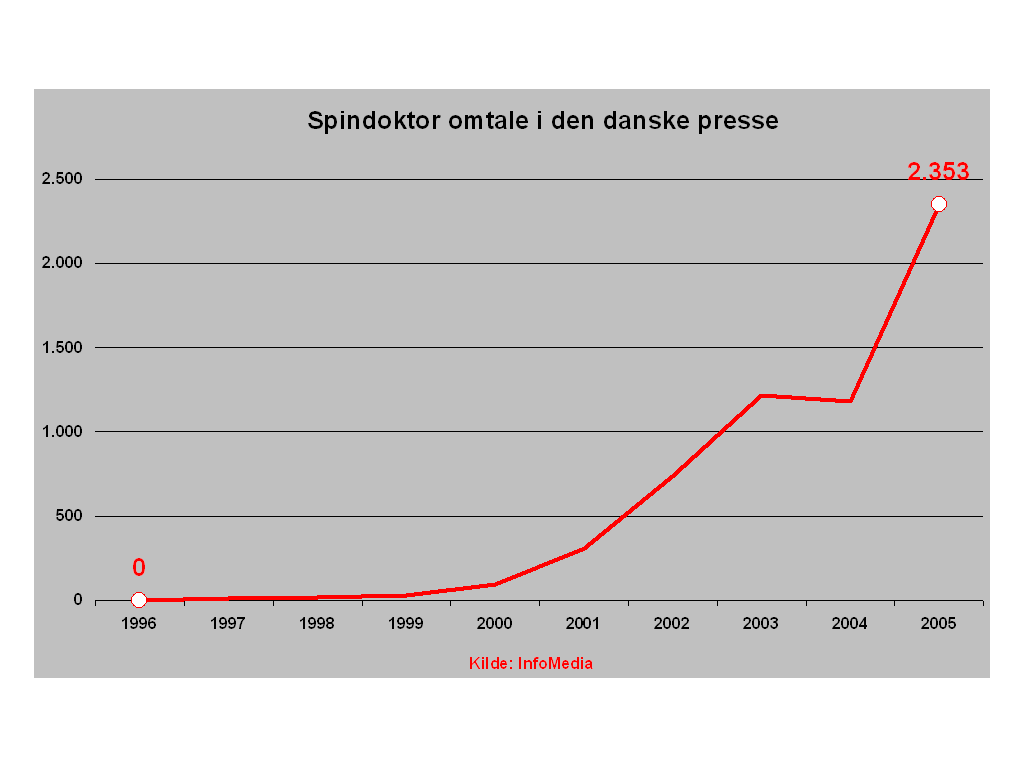
Source: Kommunikationsforum
Wednesday, June 14, 2006
Hvorfor er der så få kvindelige, politiske bloggere?
Input søges! Spørgsmålet er helt enkelt overskriften på dette post:
Hvorfor er der så få kvindelige, politiske bloggere i Danmark?
Mand eller kvinde, politisk blogger eller ej, rød, blå eller midtimellem - lad mig høre, hvad du synes og hjælp mig i jagten på det gyldne svar.
Spørgsmålet stilles i forbindelse med en universitetsopgave om politisk blogging i Danmark. Glæder mig til at høre jeres holdninger.
Hvorfor er der så få kvindelige, politiske bloggere i Danmark?
Mand eller kvinde, politisk blogger eller ej, rød, blå eller midtimellem - lad mig høre, hvad du synes og hjælp mig i jagten på det gyldne svar.
Spørgsmålet stilles i forbindelse med en universitetsopgave om politisk blogging i Danmark. Glæder mig til at høre jeres holdninger.
Wednesday, June 07, 2006
Feminists say 'goodbye neo-liberalism'
It seems to be a common perception that feminism is all about women liberating women. Sure, I understand why many would see things from this perspective - especially given the name of the 'ism' and the frequent talk about breaking down the patriarchal structures of society (which the author of this blog also contribute to).
But there is a more contemporary way of understanding feminism; feminism is about closing the gender gap and hereby liberating both men and women. Feminism is also about men's rights and giving men access to the domains that traditionally have belonged to women. In that sense fathers rights, securing men the same parental rights as women, is also an important aspect of feminism.
Personally, my preferred way of understanding feminism is even broader; feminism is about liberation and equality. Not only in terms of gender but also in relation to ethnicity, social class and age. I agree very much with Swedish feminist Tiina Rosenberg when she sees feminism as a part of a 'new left' movement in Europe:
"My vision of the Feminist Initiative was to put an end to neo-liberal politics. Here, I thought, is a need for left-wing feminists who say - no! We have insight in how gender works in society, but also in other structures such as class, ethnicity, race, homofobia, and we need to stop neo-liberalism. Just look at Paris - the suburbs are burning." (Weekendavisen, 20-1-2006, my translation from Danish)
But there is a more contemporary way of understanding feminism; feminism is about closing the gender gap and hereby liberating both men and women. Feminism is also about men's rights and giving men access to the domains that traditionally have belonged to women. In that sense fathers rights, securing men the same parental rights as women, is also an important aspect of feminism.
Personally, my preferred way of understanding feminism is even broader; feminism is about liberation and equality. Not only in terms of gender but also in relation to ethnicity, social class and age. I agree very much with Swedish feminist Tiina Rosenberg when she sees feminism as a part of a 'new left' movement in Europe:
"My vision of the Feminist Initiative was to put an end to neo-liberal politics. Here, I thought, is a need for left-wing feminists who say - no! We have insight in how gender works in society, but also in other structures such as class, ethnicity, race, homofobia, and we need to stop neo-liberalism. Just look at Paris - the suburbs are burning." (Weekendavisen, 20-1-2006, my translation from Danish)
Sunday, May 28, 2006
The Code decoded
This week I saw the (in-)famous movie The Da Vinci Code.
My judgement is...
..I really enjoyed it! To me appropriate measures of suspense, mystique and some interesting commentary.
As far as I understand a major the points of the movie is that Christianity is a construction made to distribute power in a certain way in society. Priests and kings in ancient times agreed upon the stories of Christianity so they would serve their interests the best. Hereby a society with significant inequalities between ethnicities, genders and social classes was created. Something that we - according to the movie - still see very much today. To put it crudely; Christianity is (another) tool for white men to remain those in power.
For many The Da Vince Code have raised the question if Christians are living a lie. But to me it is equally interesting to ask whether Christianity - at the end of the day - really is compatible with democracy?
My judgement is...
..I really enjoyed it! To me appropriate measures of suspense, mystique and some interesting commentary.
As far as I understand a major the points of the movie is that Christianity is a construction made to distribute power in a certain way in society. Priests and kings in ancient times agreed upon the stories of Christianity so they would serve their interests the best. Hereby a society with significant inequalities between ethnicities, genders and social classes was created. Something that we - according to the movie - still see very much today. To put it crudely; Christianity is (another) tool for white men to remain those in power.
For many The Da Vince Code have raised the question if Christians are living a lie. But to me it is equally interesting to ask whether Christianity - at the end of the day - really is compatible with democracy?
Thursday, May 18, 2006
Sometimes statistics say more than words
Women | Men | |
Share of world property | 1% | 99% |
Working hours/ income | 60% (hours); 10% (income) | 40% 90% |
Illiterates/ refugees | 60% (I) 80% (R) | 40% 20% |
via Mig og Verden (my translation from Swedish)
Subscribe to:
Posts (Atom)