Ever wonder what that illusive postmodernism is about? Sorry, but this post will not be helpful in figuring that out.
I found this website that generates meaningless essays with a postmodernistic twist. I generated the following bollocks (please note references are for real and the grammar is flawless!):
-------------------------------------
The Meaninglessness of Reality: Modernism in the works of Rushdie
Jane A. Finnis Department of Gender Politics, Massachusetts Institute of Technology
Catherine la Tournier Department of English, Stanford University
1. Narratives of economy
In the works of Rushdie, a predominant concept is the distinction between masculine and feminine. Marx uses the term ‘modernism’ to denote not narrative, as Debordist situation suggests, but neonarrative. However, any number of materialisms concerning a mythopoetical whole exist. If subtextual nationalism holds, the works of Rushdie are modernistic. Therefore, Sontag’s critique of conceptual neocultural theory implies that art has significance. The main theme of Long’s[1] analysis of Debordist situation is the collapse, and some would say the paradigm, of modern society. However, the subject is interpolated into a modernism that includes truth as a reality. Many discourses concerning Debordist situation may be found.
2. Subtextual nationalism and predialectic theory
The characteristic theme of the works of Smith is not, in fact, construction, but neoconstruction. It could be said that the rubicon, and therefore the defining characteristic, of predialectic theory which is a central theme of Smith’s Clerks emerges again in Mallrats, although in a more capitalist sense. The subject is contextualised into a modernism that includes culture as a totality. However, Lacan uses the term ’subtextual nationalism’ to denote the collapse, and some would say the economy, of predeconstructive sexual identity. Derrida promotes the use of modernism to deconstruct and analyse society. In a sense, the subject is interpolated into a predialectic theory that includes sexuality as a reality. Dahmus[2] holds that we have to choose between neomaterial dialectic theory and subcapitalist discourse.
3. Consensuses of dialectic
“Culture is meaningless,” says Sontag; however, according to Porter[3] , it is not so much culture that is meaningless, but rather the economy, and eventually the futility, of culture. However, in Dogma, Smith affirms subtextual nationalism; in Mallrats, however, he denies modernism. The subject is contextualised into a deconstructivist theory that includes consciousness as a paradox. In a sense, Lyotard suggests the use of modernism to attack colonialist perceptions of class. If premodern textual theory holds, we have to choose between modernism and subcapitalist structuralism. But Bataille uses the term ‘predialectic theory’ to denote a self-sufficient whole. Pickett[4] states that we have to choose between modernism and the textual paradigm of discourse. Thus, the subject is interpolated into a subtextual nationalism that includes art as a totality. The primary theme of Pickett’s[5] essay on Sontagist camp is not theory, but posttheory.
1. Long, N. V. ed. (1991) Subtextual nationalism in the works of Smith. University of California Press
2. Dahmus, G. (1976) Expressions of Genre: Subtextual nationalism and modernism. University of Massachusetts Press
3. Porter, Y. Q. G. ed. (1993) Modernism in the works of Cage. Harvard University Press
4. Pickett, B. (1977) The Forgotten Sea: Subtextual nationalism in the works of Joyce. Oxford University Press
5. Pickett, V. P. C. ed. (1984) Capitalism, modernism and precapitalist Marxism. O’Reilly & Associates
-------------------------------------
Monday, June 19, 2006
Sunday, June 18, 2006
Meta meta meta
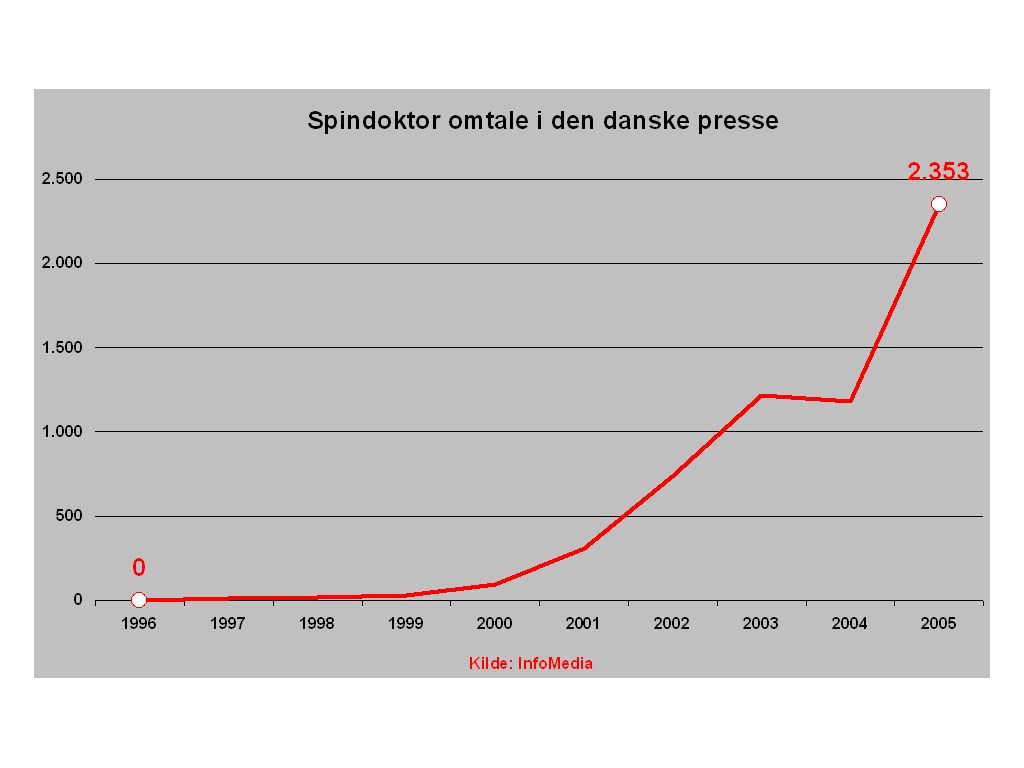
Coverage of Danish politics has never been as 'meta-' as it is today. 10 years ago spin doctors were never mentioned in the news. Last year .2.353 articles adressed spin doctors and their deeds. 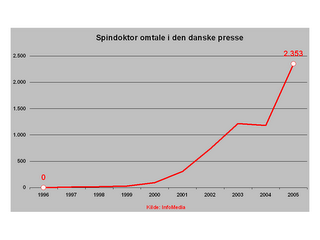
Source: Kommunikationsforum
Source: Kommunikationsforum
Wednesday, June 14, 2006
Hvorfor er der så få kvindelige, politiske bloggere?
Input søges! Spørgsmålet er helt enkelt overskriften på dette post:
Hvorfor er der så få kvindelige, politiske bloggere i Danmark?
Mand eller kvinde, politisk blogger eller ej, rød, blå eller midtimellem - lad mig høre, hvad du synes og hjælp mig i jagten på det gyldne svar.
Spørgsmålet stilles i forbindelse med en universitetsopgave om politisk blogging i Danmark. Glæder mig til at høre jeres holdninger.
Hvorfor er der så få kvindelige, politiske bloggere i Danmark?
Mand eller kvinde, politisk blogger eller ej, rød, blå eller midtimellem - lad mig høre, hvad du synes og hjælp mig i jagten på det gyldne svar.
Spørgsmålet stilles i forbindelse med en universitetsopgave om politisk blogging i Danmark. Glæder mig til at høre jeres holdninger.
Wednesday, June 07, 2006
Feminists say 'goodbye neo-liberalism'
It seems to be a common perception that feminism is all about women liberating women. Sure, I understand why many would see things from this perspective - especially given the name of the 'ism' and the frequent talk about breaking down the patriarchal structures of society (which the author of this blog also contribute to).
But there is a more contemporary way of understanding feminism; feminism is about closing the gender gap and hereby liberating both men and women. Feminism is also about men's rights and giving men access to the domains that traditionally have belonged to women. In that sense fathers rights, securing men the same parental rights as women, is also an important aspect of feminism.
Personally, my preferred way of understanding feminism is even broader; feminism is about liberation and equality. Not only in terms of gender but also in relation to ethnicity, social class and age. I agree very much with Swedish feminist Tiina Rosenberg when she sees feminism as a part of a 'new left' movement in Europe:
"My vision of the Feminist Initiative was to put an end to neo-liberal politics. Here, I thought, is a need for left-wing feminists who say - no! We have insight in how gender works in society, but also in other structures such as class, ethnicity, race, homofobia, and we need to stop neo-liberalism. Just look at Paris - the suburbs are burning." (Weekendavisen, 20-1-2006, my translation from Danish)
But there is a more contemporary way of understanding feminism; feminism is about closing the gender gap and hereby liberating both men and women. Feminism is also about men's rights and giving men access to the domains that traditionally have belonged to women. In that sense fathers rights, securing men the same parental rights as women, is also an important aspect of feminism.
Personally, my preferred way of understanding feminism is even broader; feminism is about liberation and equality. Not only in terms of gender but also in relation to ethnicity, social class and age. I agree very much with Swedish feminist Tiina Rosenberg when she sees feminism as a part of a 'new left' movement in Europe:
"My vision of the Feminist Initiative was to put an end to neo-liberal politics. Here, I thought, is a need for left-wing feminists who say - no! We have insight in how gender works in society, but also in other structures such as class, ethnicity, race, homofobia, and we need to stop neo-liberalism. Just look at Paris - the suburbs are burning." (Weekendavisen, 20-1-2006, my translation from Danish)
Sunday, May 28, 2006
The Code decoded
This week I saw the (in-)famous movie The Da Vinci Code.
My judgement is...
..I really enjoyed it! To me appropriate measures of suspense, mystique and some interesting commentary.
As far as I understand a major the points of the movie is that Christianity is a construction made to distribute power in a certain way in society. Priests and kings in ancient times agreed upon the stories of Christianity so they would serve their interests the best. Hereby a society with significant inequalities between ethnicities, genders and social classes was created. Something that we - according to the movie - still see very much today. To put it crudely; Christianity is (another) tool for white men to remain those in power.
For many The Da Vince Code have raised the question if Christians are living a lie. But to me it is equally interesting to ask whether Christianity - at the end of the day - really is compatible with democracy?
My judgement is...
..I really enjoyed it! To me appropriate measures of suspense, mystique and some interesting commentary.
As far as I understand a major the points of the movie is that Christianity is a construction made to distribute power in a certain way in society. Priests and kings in ancient times agreed upon the stories of Christianity so they would serve their interests the best. Hereby a society with significant inequalities between ethnicities, genders and social classes was created. Something that we - according to the movie - still see very much today. To put it crudely; Christianity is (another) tool for white men to remain those in power.
For many The Da Vince Code have raised the question if Christians are living a lie. But to me it is equally interesting to ask whether Christianity - at the end of the day - really is compatible with democracy?
Thursday, May 18, 2006
Sometimes statistics say more than words
Women | Men | |
Share of world property | 1% | 99% |
Working hours/ income | 60% (hours); 10% (income) | 40% 90% |
Illiterates/ refugees | 60% (I) 80% (R) | 40% 20% |
via Mig og Verden (my translation from Swedish)
Sunday, May 14, 2006
Go youth!
I am truly sorry that I can't joint the demos in Denmark this Wednesday. In spite I don't agree with their take on early retirement benefit I still wish 17.maj-initiativet the best of luck with their events around the country. It is really cool to see so many different youth organizations cooperating. Thumbs up!
Friday, May 12, 2006
100 years ago
“I have a mother, and I have a wife and a sister and daughters, and I wish to continue in the position of their supporter and their protector, and not to place them under the necessity of protecting their own political position. I do not wish them to have extended to them the right not only to vote, but to sit in this Chamber. It is man's duty to be here, and it is woman's duty to attend to the family.”
William Knox in an Australian House of Assembly debate, 1902.
William Knox in an Australian House of Assembly debate, 1902.
Friday, May 05, 2006
One of our neighbours has a point
"I get really angry when I look at Sweden today. [...] Just look at Paris - the suburbs are burning. The immigrants live in the horrible, ghettoized suburbs where the houses are collapsing. In Sweden you see that the barriers of class increase. We are not talking about industrial workers, because soon we won't have any industry, but instead we have many proletarized fugitive and immigrant groups. Single parents, predominantly women. Those are the new-poor in Europe."
- Tiina Rosenberg, co-founder of the Swedish feminist party "Feministiskt Initiativ".
- Tiina Rosenberg, co-founder of the Swedish feminist party "Feministiskt Initiativ".
Friday, April 21, 2006

Friday, April 07, 2006
A video greeting
Yes, what do you want to know, Anders Fogh?
...what I think about your welfare reform? You mean this anti-youth project where my parents' generation runs clear and leaves the bill for their children? Well, I put it in a video for you. Enjoy.
...what I think about your welfare reform? You mean this anti-youth project where my parents' generation runs clear and leaves the bill for their children? Well, I put it in a video for you. Enjoy.
Wednesday, April 05, 2006
And I feel the whip
I wonder how the huge group of Danish students that voted for our governmental parties feel when they think about the government's upcoming welfare reform.
Is it something like this?
I tell you I love you
And I always will
And I know that you can't tell me
So I'm left to pick up
The hints, the little symbols of your devotion
I feel your fists
And I know it's out of love
And I feel the whip
And I know it's out of love
I feel your burning eyes burning holes
Straight through my heart
It's out of love
- Antony and the Johnsons
Is it something like this?
I tell you I love you
And I always will
And I know that you can't tell me
So I'm left to pick up
The hints, the little symbols of your devotion
I feel your fists
And I know it's out of love
And I feel the whip
And I know it's out of love
I feel your burning eyes burning holes
Straight through my heart
It's out of love
- Antony and the Johnsons
Sunday, March 19, 2006
Nordic Men
As a Nordic woman I find the Nordic cooperative television project "The Nordic Man" very interesting - and incredibly amusing!
After watching two episodes the Nordic Man comes across as somewhat lost to me. In a world filled with independent women that have invaded almost all traditional male domains the Nordic Man struggles for his masculinity. What is a man to do when women don't need his protection anymore? When they hunt their own food - within his territory?
Women are an active part of the working filed in the Nordic countries and traditional male territory is beginning to get inhabited by women. In Norway they have taken a radical step to get women to the core within trade and industry. A new law states that 40 % of all board members must be women, or else the board will be dissolved by force! In the programme about men and work we look at how men respond to this, and how the men themselves gain new territory within working fields that used to belong to women.
After watching two episodes the Nordic Man comes across as somewhat lost to me. In a world filled with independent women that have invaded almost all traditional male domains the Nordic Man struggles for his masculinity. What is a man to do when women don't need his protection anymore? When they hunt their own food - within his territory?
“Men and Love”
In the programme about men and love we look at the group of men that have a hard time catching the independent Nordic women that tend to leave the small villages and take a higher education in the cities, leaving behind a group of heart aching under- graduated men. The programme shows the men’s dilemma, but also how inventive souls have taken positive steps to free themselves from their misfortune.
Women are an active part of the working filed in the Nordic countries and traditional male territory is beginning to get inhabited by women. In Norway they have taken a radical step to get women to the core within trade and industry. A new law states that 40 % of all board members must be women, or else the board will be dissolved by force! In the programme about men and work we look at how men respond to this, and how the men themselves gain new territory within working fields that used to belong to women.
Poor guy, the Nordic Man.
Friday, March 17, 2006
Britpop, my generation and revolution
Yesterday I watched a documentary about Tony Blair's New Labour and the role of Britpop in the British landslide election of 1997. The film tries to reveal how New Labour, so to speak, abused artists such as Oasis, Pulp and Blur to win the hearts of young voters. "New Labour grabbed the moment" - as a music journalist puts it in the documentary - and began associating themselves with Britpop bands. And the artists went a long with it - for example the memorable moment of the Gallagher brothers praising Tony Blair at BritAwards.
The connection to Britpop enabled New Labour to reach an otherwise very political-cynical audience that was fed up with Thatcherism, suburbian life and American popular culture. But after the victory of New Labour reality struck the Britpop artists. "Maybe I was naive but I thought I had been taken in because they wanted to hear what I had to say. But once they were where they wanted to be it was just fuck-off," says Damon Albarn, former leadsinger in Blur. Blair was just a politician like the rest. The change the artists had advocated for didn't come.
But it is interesting to consider if the Britpop artists would have been able to initiate a social change by themselves. I guess, what they wished for was some sort of revolution - would they have the potential to fuel a revolution if Tony Blair had not been there? Or was being an ornament for New Labour as political as Britpop could get?
In my opinion the I-don't-really-give-a-fuck attitude of Britpop protagonist Liam Gallagher makes it pretty evident how unlikely it was that Britpop would foster revolution. At the end of the day Britpop lacked will and aims. Today, I think the same apathy goes for many Western youth cultures. It seems to me that the radical youth movements of my generation simply don't have the energy and the organizational skill necessary to actually make a difference. If New Labour had not taken advantage of the situation in the nineties then Britpop probably wouldn't have had political effect at all. How sad.
The connection to Britpop enabled New Labour to reach an otherwise very political-cynical audience that was fed up with Thatcherism, suburbian life and American popular culture. But after the victory of New Labour reality struck the Britpop artists. "Maybe I was naive but I thought I had been taken in because they wanted to hear what I had to say. But once they were where they wanted to be it was just fuck-off," says Damon Albarn, former leadsinger in Blur. Blair was just a politician like the rest. The change the artists had advocated for didn't come.
But it is interesting to consider if the Britpop artists would have been able to initiate a social change by themselves. I guess, what they wished for was some sort of revolution - would they have the potential to fuel a revolution if Tony Blair had not been there? Or was being an ornament for New Labour as political as Britpop could get?
In my opinion the I-don't-really-give-a-fuck attitude of Britpop protagonist Liam Gallagher makes it pretty evident how unlikely it was that Britpop would foster revolution. At the end of the day Britpop lacked will and aims. Today, I think the same apathy goes for many Western youth cultures. It seems to me that the radical youth movements of my generation simply don't have the energy and the organizational skill necessary to actually make a difference. If New Labour had not taken advantage of the situation in the nineties then Britpop probably wouldn't have had political effect at all. How sad.
Wednesday, March 15, 2006
Being political
"As feminist political philosophers have repeatly shown, the incorporation of "the feminine" in the political domain has been constructed by otherwise sharply opposed authors as undermining its rational and universal basis. In the form of explicit treatment of the nature of politics such views have disappeared from the public arena. However, when reviewing the experience of women in politics, their struggle with the dominant codes of conduct, and their representation in various media, it is clear that a practice, politics is still very much constructed as male territory." (Liesbet van Zoonen, 2004)
Today, I have joined a new blog community - a political one! Which of course is great and I hope my blog will attract some readers (eventhough more frequent updates might be a necessity!). Nevertheless, it seems that my gender somehow turned out to be relevant in relation to this. And I wonder why? Maybe I will have another way of adressing politics than the opposite gender. Maybe I'll mix my postings on politics with other types of postings - or maybe I'll do "hybrids". Or maybe I'll just do it the old-fashioned way and comment on the cover stories of Danish newspapers. Hell, maybe I'll even bring up feminism. We'll see. One thing is for sure: This blog is political. It might just not be in the way everybody expects it to be.
Today, I have joined a new blog community - a political one! Which of course is great and I hope my blog will attract some readers (eventhough more frequent updates might be a necessity!). Nevertheless, it seems that my gender somehow turned out to be relevant in relation to this. And I wonder why? Maybe I will have another way of adressing politics than the opposite gender. Maybe I'll mix my postings on politics with other types of postings - or maybe I'll do "hybrids". Or maybe I'll just do it the old-fashioned way and comment on the cover stories of Danish newspapers. Hell, maybe I'll even bring up feminism. We'll see. One thing is for sure: This blog is political. It might just not be in the way everybody expects it to be.
Tuesday, March 14, 2006
International woman
A bit delayed this blog celebrates International Women's Day:
You are my sister, we were born
So innocent, so full of need
There were times we were friends but times I was so cruel
Each night I'd ask for you to watch me as I sleep
I was so afraid of the night
You seemed to move through the places that I feared
You lived inside my world so softly
Protected only by the kindness of your nature
You are my sister
And I love you
May all of your dreams come true
We felt so differently then
So similar over the years
The way we laugh the way we experience pain
So many memories
But theres nothing left to gain from remembering
Faces and worlds that no one else will ever know
You are my sister
And I love you
- Antony and the Johnsons
You are my sister, we were born
So innocent, so full of need
There were times we were friends but times I was so cruel
Each night I'd ask for you to watch me as I sleep
I was so afraid of the night
You seemed to move through the places that I feared
You lived inside my world so softly
Protected only by the kindness of your nature
You are my sister
And I love you
May all of your dreams come true
We felt so differently then
So similar over the years
The way we laugh the way we experience pain
So many memories
But theres nothing left to gain from remembering
Faces and worlds that no one else will ever know
You are my sister
And I love you
- Antony and the Johnsons
Monday, March 13, 2006
Sunday, March 12, 2006
The left-wing saviour
Today the Danish newspaper Politiken brought an incredible photo of the Danish politician Marianne Jelved. She is portrayed as a sort of opposition Messiah. Great shot!
I don't really understand the current project of the Danish opposition though. But that is another discussion.
I don't really understand the current project of the Danish opposition though. But that is another discussion.

Tuesday, March 07, 2006
Another clever commentary
Thanks to TV2-Sputnik I just watched the latest episode of the Danish comedy "Klovn" (in English: "Clown"). Do watch it! It has a clever commentary to the ongoing debate about freedom-of-speech.
That exactly this TV series comment on the incident is interesting. The lead role is played by Frank Hvam who Jyllands-Posten referred to when the newspaper published the drawings in September last year. This is the headline and first few lines of the article:
"The Face of Mohammed
The comedian Frank Hvam recently realized that he does "not dare to joke about the Koran on TV." An illustrator that drawed the prophet Mohammed for a children's book wish to be anynomous. The same goes for western European translators of a collection of essays that are critical of Islam." (Jyllands-Posten, September 30 2006)
That exactly this TV series comment on the incident is interesting. The lead role is played by Frank Hvam who Jyllands-Posten referred to when the newspaper published the drawings in September last year. This is the headline and first few lines of the article:
"The Face of Mohammed
The comedian Frank Hvam recently realized that he does "not dare to joke about the Koran on TV." An illustrator that drawed the prophet Mohammed for a children's book wish to be anynomous. The same goes for western European translators of a collection of essays that are critical of Islam." (Jyllands-Posten, September 30 2006)
Thursday, March 02, 2006
Clever commentary
It does not happen that often - but once in a while I agree with the Danish prime minister. This quote about the infamous cartoons and the attitude of Danish intellectuals I even applaude:
"Writers and others that at the utmost benefit from freedom-of-speech have failed when it comes to this matter. And I think I know why - they see it in a totally different light [...] They disapprove of the Danish Peoples Party, they disapprove of Jyllands-Posten and they disapprove of the government. And possibly in that order. Because it is close to hate when it comes to these three factors they seem unable to stand up and defend freedom-of-speech..."
Politiken, February 28 2006 (my translation from Danish)
"Writers and others that at the utmost benefit from freedom-of-speech have failed when it comes to this matter. And I think I know why - they see it in a totally different light [...] They disapprove of the Danish Peoples Party, they disapprove of Jyllands-Posten and they disapprove of the government. And possibly in that order. Because it is close to hate when it comes to these three factors they seem unable to stand up and defend freedom-of-speech..."
Politiken, February 28 2006 (my translation from Danish)
Subscribe to:
Posts (Atom)