The debate about the headwear of Muslim women has risen again in Denmark. This time it is fuelled by the case of a child minder who, according to some, wears a burka during working hours.
First of all, I think we should set things straight with respect to religious head wear. As far as I understand this is a burka and this is a niqab. The latter is what the child minder in Odense wears. Secondly, she puts on the niqab when she goes outside. In her home she wears a headscarf tied under the chin; allowing the children to see her face and expressions.
In the Danish debate a major argument for a ban against headscarves is that they are, supposedly, symbols of the oppression of women. In the case of symbols (please pay special attention to the word!) Danish politicians seem very willing to take action. Since the Danish Minister of Family Affairs recognized the municipality of Odense’s right to forbid their employees to wear religious clothing, there has been no end to the political announcements. A spokesperson from the Danish Liberal Party, one of the parties in government, describes it as a ‘freedom right’ that the Danish municipalities are allowed to ban religious clothing to their likening. Next to Odense several other municipalities have declared that they will make use of this freedom. In the case of symbols there is a lot of political goodwill when it comes to using regulation as a tool to, supposedly, improve women’s conditions.
Let us turn away from religious clothing for a moment and look at case that, to me and many others, is an unambiguous expression of the suppression of women. Some call it the oldest profession in the world. Others call it exploitation of women’s bodies. I am talking about prostitution. An estimate is at least 4,730 (the far majority being women) are selling their bodies in Denmark. There is a serious lack of knowledge about prostitution in my home country, but here are some European facts:
- Data provided by the British Medical Journal on the experience of client violence against women prostitutes indicates that 93 % of women had an experience of client violence (British Medical Journal: Do you want the latest evidence? “Personal characteristics, drug use, and experience of client violence by prostitutes working indoors or outdoors”, downloaded 17/2/2003)
- Around 80 % of women in prostitution have been sexually abused in their childhood (Fact sheet on Human Rights Violations, Prostitution Research & Education, Melissa Farley, http://www.prostitutionresearch.com/)
- The average age of women entering into prostitution is 13 or 14; there is no evidence to suggest that this age is decreasing (La prostitution un métier comme un autre?”, Yolande Geadah ; VLB éditeur, 2001, p. 137)
Data is compiled by womenlobby.org
As Reden, a drop-in centre for women in the prostitution environment in Copenhagen, explains on its web page:
“Prostitution – to sell you own body via prostitution and pornography – will always be the extreme sale and a situation that can be compared to nothing else. There are situations where people think they only have their body left to trade with, or situations where the body is the only demanded commodity. […] It often has long-term and destructive consequences when a woman has to let her body invade by thousands of men she does not herself desire. To survive she will have to switch off her emotions and ability to feel. The price can be that it will become ever more difficult to turn on her feelings again. The woman risks developing insensitivity towards other people, depression and the lack of ability to feel herself and her own needs.” (my translation from Danish)
Talking about offense against women’s rights prostitution is an obvious case. Still, myths of “the happy prostitute” and “prostitution is a woman’s personal choice” are alive and well in Denmark (and many other countries for that sake). Unlike the war against headscarves, supposedly symbols of suppression of women, there is not much political goodwill when it comes to prostitution. In the case of symbols politicians are more than willing to make rules and regulations. In the case of physical exploitation of women it is almost a taboo to talk about criminalizing the buyer. Sweden and Norway, two countries we normally compare ourselves to, have already passed laws. Still, there is very little discussion about banning the purchase of sex in Denmark. Maybe the symbolic value is not high enough?
Or perhaps is the suppression of women not really on the agenda of Danish politicians? Many of them seem to regard symbols as a much more grave manifestation of offense than actual physical abuse. At the end of the day the fight against symbols is unrelated to women’s rights. It appears to be just another expression of hostility towards Muslim culture and Muslims.
A selection of the (scarce) resources available on prostitution in Denmark (Danish-language):
Publications from 'Theme Prostitution' ('Theme Prostitution' is an activity under a government agency)
The extent of prostitution in Denmark
Facts about prostitution compiled by the Danish Socialist People's Party
Sunday, May 06, 2007

Friday, May 04, 2007
The oldest profession in the world
If anyone should still suffer from convictions such as "prostitution is a woman's own choice" and "the sex industry is fun" this video from the European Women's Lobby is worth watching.
Among some of the video's statistics are:
- 92-95 % of prostituted women wants to get out of prostitution
- In large European cities between 67 and 90 % of prostitutes are foreigners
- In my home country Denmark there is about 7000 victims of trafficking. In Sweden (where it is illegal to buy sex) the number is more than ten times lower; 400 to 600.
Among some of the video's statistics are:
- 92-95 % of prostituted women wants to get out of prostitution
- In large European cities between 67 and 90 % of prostitutes are foreigners
- In my home country Denmark there is about 7000 victims of trafficking. In Sweden (where it is illegal to buy sex) the number is more than ten times lower; 400 to 600.
Tuesday, May 01, 2007
Breasts should be respected the way they are
An artist initiates debate about breast enlargements in China. Watch the report here.
Saturday, April 07, 2007
British school children learn about alternative family patterns
Danish politician and member of parliament Martin Henriksen (the Danish People's Party) has earlier informed the world about his idea Danish schools should teach children and teenagers about sexual abstinence.
I have my doubts whether preaching abstinence is really necessary but I generally like the idea about updating the sex education of Danish elementary school. May I suggest to Mr. Henriksen to take the suggestion made in this article into consideration?
To me it comes across as a problem if the only types of emotional relationships Danish children learn about are the heterosexual ones. It is heteronormativity at its worst. Martin Spangsbro-Pedersen from the Danish National Association of Gays & Lesbians comments on the fact that British school children (from the age of four) learn about homosexual relationships:
"It is very positive. It is important to introduce children to other family patterns than the 'normal ones'. I would like to see the same development in Denmark."
Besides that I find the book titles introduced to British school children kind of cute: "Tango Makes Three" (about a penguin boy raised by two penguin fathers) and "King and King and Family" (I assume something with a prince who finds his prince and has a fairy-tale wedding).
Sadly I have a feeling Mr. Henriksen will not be too keen on my proposal. Him and his party are not exactly famous for supporting families different from the nuclear one.
I have my doubts whether preaching abstinence is really necessary but I generally like the idea about updating the sex education of Danish elementary school. May I suggest to Mr. Henriksen to take the suggestion made in this article into consideration?
To me it comes across as a problem if the only types of emotional relationships Danish children learn about are the heterosexual ones. It is heteronormativity at its worst. Martin Spangsbro-Pedersen from the Danish National Association of Gays & Lesbians comments on the fact that British school children (from the age of four) learn about homosexual relationships:
"It is very positive. It is important to introduce children to other family patterns than the 'normal ones'. I would like to see the same development in Denmark."
Besides that I find the book titles introduced to British school children kind of cute: "Tango Makes Three" (about a penguin boy raised by two penguin fathers) and "King and King and Family" (I assume something with a prince who finds his prince and has a fairy-tale wedding).
Sadly I have a feeling Mr. Henriksen will not be too keen on my proposal. Him and his party are not exactly famous for supporting families different from the nuclear one.
Wednesday, March 28, 2007
Another constitution-inspired petition
 Earlier I have posted on two citizens' initiatives, Oneseat and Nuclear Power No Thanks, inspired by article 47 of the proposed European Constitution.
Now a new one has seen the light of the day. The 112 petition encourages the European Commission to ensure better aid to Europeans who dial 112. The web page explains:
In the EU, 15 to 30 % of the emergency calls get an inappropriate or even no answer at all!
The European Commission’s own figures show that every year 5,000 more lives as well as EUR 5,000,000,000 could be saved.
Therefore, I request the European Commission to ensure an efficient 112 service all over the EU to my family and me for the 50th anniversary of the United Europe in 2007.
Some of the testimonies on the web page is also quite thought-provoking:
Kristina called 112 in Belgium. The operator did not understand French or English. The ambulance arrived only one and a half hour later...
Oliver lives at the border between Germany and Austria. Once he had to call an emergency number in Austria but he did not know which one to call...
Manuel called the 112 in Spain and finally had to carry his father to the hospital emergency unit on his own because of the poor and slow 112 service...
The European Emergency Number Association is behind the petition.
PS: If some of you did not know 112 is the emergency number that you can use in all EU member states.
Saturday, March 17, 2007
No, we do not have genitalia
Vagina!
Hush. Apparently you are not suppose to say that.
From News for Greens:
"A public high school has suspended three students who disobeyed officials by saying the word “vagina” during a reading from a well-known feminist play.
The honour students, Megan Reback, Elan Stahl and Hannah Levinson, included the word during their reading of “The Vagina Monologues” because “it wasn’t crude and it wasn’t inappropriate and it was very real and very pure,” Reback said.
Their defiant stand is being applauded by the play’s author, who said Tuesday that the school should be celebrating, rather than punishing, the three juniors.
“Don’t we want our children to resist authority when it’s not appropriate and wise?” said Eve Ensler, author of “The Vagina Monologues.”"
It is also interesting to consider that this story (according to News for Greens) were more prominently covered in Canada than in the US where it took place.
Hush. Apparently you are not suppose to say that.
From News for Greens:
"A public high school has suspended three students who disobeyed officials by saying the word “vagina” during a reading from a well-known feminist play.
The honour students, Megan Reback, Elan Stahl and Hannah Levinson, included the word during their reading of “The Vagina Monologues” because “it wasn’t crude and it wasn’t inappropriate and it was very real and very pure,” Reback said.
Their defiant stand is being applauded by the play’s author, who said Tuesday that the school should be celebrating, rather than punishing, the three juniors.
“Don’t we want our children to resist authority when it’s not appropriate and wise?” said Eve Ensler, author of “The Vagina Monologues.”"
It is also interesting to consider that this story (according to News for Greens) were more prominently covered in Canada than in the US where it took place.
Monday, March 12, 2007
Democrats win

This is the results of my earlier poll. It seems the US would have a democratic president if readers of Scratching the Surface were to decide. Perhaps not an extremely surprising result since many of my readers are European.
Thanks for your participation. If nothing else this poll made me aware how hard it is to 'measure' the political opinions of people living in different political systems. It is really difficult to find political categories everyone can relate to without, at the same time, making them so 'broad' that the poll will, more or less, say nothing at all.
Sunday, March 11, 2007
New design
Pink-ish and raw - I know! However, I feel it sends out that feminist vibe. Thanks to Feministiskt Initiativ for inspiration to the colour. Enjoy!
Scratching the Surface expands business
I am now officially back in Brussels and have begun writing my masters thesis. For anyone curious about what I will spent the next half year on I cordially invite you to visit mymediathesis.blogspot.com. I will do my best to update frequently! Deadline is 1st of August.
PS: The name of the blog is the title I have been proposed by my thesis adviser. Does not really say a lot, I know.
PS: The name of the blog is the title I have been proposed by my thesis adviser. Does not really say a lot, I know.
Saturday, March 10, 2007
Friday, March 09, 2007
Scandi-joke
Recently, with International Women's Day as the occasion, I received this curiosity (PDF); an except from a fifties textbook on how to be a good wife. The absurdity of its advice becomes even more apparent if you reverse the gender roles (PDF).
My apologies to readers whom are not acquainted with Scandinavian languages.
My apologies to readers whom are not acquainted with Scandinavian languages.
Friday, February 23, 2007
Tell me about you!
If you read Danish I hope you will find the time to fill in a short questionnaire about my blog:
Gå til spørgeskema
The questionnaire is from Blog Tjek 07; a group of Danish bloggers investigating blog readers.
Gå til spørgeskema
The questionnaire is from Blog Tjek 07; a group of Danish bloggers investigating blog readers.
Thursday, February 15, 2007
Radio with a European twist
News media that cross borders is a rare phenomenon - at least if we consider their popularity. Most people get their news from national media where events are interpreted and presented in a national context. This is not surprising considering most news media are produced nationally: Danish television news are produced by Danes within the borders of Denmark.
The radio programme Network Europe is an interesting experiment with respect to this. It is a cooperation between ten radio stations from all over Europe - from Scandinavia to Eastern Europe. Together they assemble a current affairs programme with stories from many corners of the continent.
Without doubt the programme has many flaws. It is a bit monotonous, the topics tend to be very 'heavy', and the sound quality is varying. Still, I like the idea about crossborder cooperation and the fact that the programmes offer stories that national media usually filters out.
Listen to the programmes in English or German.
Here in Hamburg some of my class mates are currently conducting a survey among people who have listened to the programme. If you have ten minutes they would be very happy if you would answer their online questionnaire.
The radio programme Network Europe is an interesting experiment with respect to this. It is a cooperation between ten radio stations from all over Europe - from Scandinavia to Eastern Europe. Together they assemble a current affairs programme with stories from many corners of the continent.
Without doubt the programme has many flaws. It is a bit monotonous, the topics tend to be very 'heavy', and the sound quality is varying. Still, I like the idea about crossborder cooperation and the fact that the programmes offer stories that national media usually filters out.
Listen to the programmes in English or German.
Here in Hamburg some of my class mates are currently conducting a survey among people who have listened to the programme. If you have ten minutes they would be very happy if you would answer their online questionnaire.
Tuesday, February 13, 2007
The witch is back
 Multitasking like crazy. While desperately browsing the web for accomodation in Brussels and typing in an assignment about the Danish media landscape my ears have devoted their full attention to this new album - a tribute to Yoko Ono.
As the Danish broadcaster DR write in their review the album is "colourful and messy". Still, I like it. Especially Peaches, Blow Up and Le Tigre make great performances as their music is mixed with the voice of the witch herself - Ono.
As a statement the tribute is interesting as well. As Rasmus Junge from DR puts it:
"Exactly the negative, public image of Yoko Ono as a cynical and calculating pop-avantgardist is the focal point for the tribute album 'Yes, I'm a Witch', that sttempts to add some nuances to this otherwise black-and-white representation, and at the same time advocates her importance as a gender-conscious, female artist." (my translation from Danish)
Tuesday, January 30, 2007
Former Pulp-protagonist fights back
I guess, Jarvis Cocker got a bit upset with New Labour after the '97 British elections.
Earlier I have expressed my disappointment in brit pop and the political involvement of brit pop bands. Still, I am pretty impressed with this new song by the former lead singer in Pulp.
Well did you hear, there’s a natural order.
Those most deserving will end up with the most.
That the cream cannot help but always rise up to the top,
Well I say: Shit floats.
If you thought things had changed,
Friend you’d better think again,
Bluntly put in the fewest of words,
Cunts are still running the world,
Cunts are still running the world.
Now the working classes are obsolete,
They are surplus to societies needs,
So let ‘em all kill each other,
And get it made overseas.
That’s the word don’t you know,
From the guys thats running the show,
Lets be perfectly clear boys and girls,
Cunts are still running the world,
Cunts are still running the world.
Oh feed your children on Cray fish and Lobster tails,
Find a school near the top of the league,
In theory I respect your right to exist,
I will kill ya if you move in next to me,
Ah it stinks, it sucks, it’s anthropologically unjust,
But the takings are up by a third,
Oh So Cunts are still running the world,
Cunts are still running the world.
Your free market is perfectly natural,
Or do you think that I’m some kind of dummy,
It’s the ideal way to order the world,
Fuck the morals, does it make any money?
And if you don’t like it? Then leave.
Or use your right to protest on the street,
Yeah, use your rights but don’t imagine that it’s heard, Oh no no,
Cunts are still running the world,
Cunts are still running the world.
Earlier I have expressed my disappointment in brit pop and the political involvement of brit pop bands. Still, I am pretty impressed with this new song by the former lead singer in Pulp.
Well did you hear, there’s a natural order.
Those most deserving will end up with the most.
That the cream cannot help but always rise up to the top,
Well I say: Shit floats.
If you thought things had changed,
Friend you’d better think again,
Bluntly put in the fewest of words,
Cunts are still running the world,
Cunts are still running the world.
Now the working classes are obsolete,
They are surplus to societies needs,
So let ‘em all kill each other,
And get it made overseas.
That’s the word don’t you know,
From the guys thats running the show,
Lets be perfectly clear boys and girls,
Cunts are still running the world,
Cunts are still running the world.
Oh feed your children on Cray fish and Lobster tails,
Find a school near the top of the league,
In theory I respect your right to exist,
I will kill ya if you move in next to me,
Ah it stinks, it sucks, it’s anthropologically unjust,
But the takings are up by a third,
Oh So Cunts are still running the world,
Cunts are still running the world.
Your free market is perfectly natural,
Or do you think that I’m some kind of dummy,
It’s the ideal way to order the world,
Fuck the morals, does it make any money?
And if you don’t like it? Then leave.
Or use your right to protest on the street,
Yeah, use your rights but don’t imagine that it’s heard, Oh no no,
Cunts are still running the world,
Cunts are still running the world.
Monday, January 22, 2007
This will be interesting
"I'm in. And I'm in to win. Today I am announcing that I will form an exploratory committee to run for president," states a press release from Hillary Clinton, Senator from New York.
Out of Iraq, energy independence, social security and affordable healthcare are causes on the agenda of the possible first woman to enter the White House as president.
Check out the video in which Hillary Clinton announces her candidacy.
During recent years several scholars have looked into the way media covered Hillary Clinton during her time as First Lady. One of the most interesting articles I have come across is that of Charlotte Templin which evaluates cartoon images of America's most famous female politician. This is an extract from the abstract:
"The cartoon images of Hillary Clinton suggest a backlash against the professional woman, as evidenced by the obsession with Hillary among cartoonists, the continual use of cliches and stereotypes, and the overt sexism in the images and symbols used to depict her. Cartoonists see Hillary violating gender norms. Cartoon images fall into the following categories: gender reversals, Hillary as radical feminist and emasculator, domestic imagery, woman as body, the public woman, cherchez la femme, and the wife the husband wants to get rid of. "
I will keep my fingers crossed for more fair media coverage this time.
Out of Iraq, energy independence, social security and affordable healthcare are causes on the agenda of the possible first woman to enter the White House as president.
Check out the video in which Hillary Clinton announces her candidacy.
During recent years several scholars have looked into the way media covered Hillary Clinton during her time as First Lady. One of the most interesting articles I have come across is that of Charlotte Templin which evaluates cartoon images of America's most famous female politician. This is an extract from the abstract:
"The cartoon images of Hillary Clinton suggest a backlash against the professional woman, as evidenced by the obsession with Hillary among cartoonists, the continual use of cliches and stereotypes, and the overt sexism in the images and symbols used to depict her. Cartoonists see Hillary violating gender norms. Cartoon images fall into the following categories: gender reversals, Hillary as radical feminist and emasculator, domestic imagery, woman as body, the public woman, cherchez la femme, and the wife the husband wants to get rid of. "
I will keep my fingers crossed for more fair media coverage this time.
Sunday, January 21, 2007
Operation Red Dragon

It is not an easy task to communicate EU politics. The structures and decision-making processes of the European institutions are rather complex and the same goes for many of the causes and issues raised at the European level.
So how do you make high-level politics more accessible and appealing to European citizens? ALDE, the Alliance of Liberals and Democrats for Europe, has a suggestion; a cartoon. In 'Operation Red Dragon' you are invited to follow Elisa Correr, a member of the European Parliament, as she gets embroiled in a risky adventure taking place in Brussels and the fictitious country of Fang Dong. Every week new pages are made available on ALDE's web page.
If you prefer learning about the EU in a more traditional format I recommend the EU-published booklet 'How the European Union works - a citizen’s guide to the EU institutions'. It is 52 pages long but very easy to read - or just browse through.
Thursday, January 18, 2007

Wednesday, January 17, 2007
Famous feminist #6

"We are talking about a society in which there will be no roles other than those chosen or those earned; we are really talking about humanism."
Gloria Steinem (b. 1934) is an American feminist icon, journalist, and women's rights advocate. She is the founder and original publisher of Ms. Magazine.
Steinem entered Smith College on scholarship in 1952, majoring in government studies and becoming politically active in Adlai Stevenson's presidential campaign. After graduation she studied in India for two years, after which she returned to America, where she believed that she had difficulty finding a journalism position because males had hiring preference.
Steinem eventually got a political assignment covering George McGovern's presidential campaign, which led to a position in a New York magazine. She became politically active in the feminist movement, and the media seemed to appoint Steinem as a feminist leader of sorts. Steinem brought other notable feminists to the fore and toured the country with lawyer Florynce Rae ("Flo") Kennedy, and in 1971, cofounded the National Women's Political Caucus as well as the Women's Action Alliance. In 1972, she helped start the feminist Ms. Magazine and wrote for the magazine until it was sold in 1987. The magazine was bought by the Feminist Majority Foundation in 2001, and Steinem remains on the masthead as one of six founding editors and serves on the advisory board. Steinem cofounded the Coalition of Labor Union Women in 1974, and participated in the National Conference of Women in Houston, Texas in 1977. She became Ms. magazine's consulting editor when it was revived in 1991, and she was inducted into the National Women's Hall of Fame in 1993.
Source: Wikipedia.org
More than the little mermaid
"In the Danish sense security is to have a bottle opener tied to your rocking chair"
- Benny Andersen, Danish author
The cartoon crisis fuelled a big debate on what it means to be Danish - not just locally in Denmark but internationally as well. What those Danes are about really puzzled media world-wide; among these the famous current affairs programme 60 Minutes and Comedy Central's The Daily Show.
To me, born and raised in Denmark, the descriptions that capture the best what it means to be Danish are those of writer Benny Andersen. His poem collection 'Cosmopolitan in Denmark and other poems about the Danes' is a great reader for anyone who wishes to understand the illusive concept of 'Danish-ness' a little better.
Reading Andersen's poems is also a great way of escaping the stereotypes that are often applied to Denmark and its citizens; a fairy tale nation, the home country of Hans Christian Andersen, a cornucopia of pastries, butter cookies and hot-dogs. No wonder, people were so surprised when the cartoon crisis broke out. How could this cute, prosperous miniature country suddenly become object of the anger of millions? Andersen gives insight into a Danish identity that is a lot more complex and ambiguous than the glossy picture often painted by mass media.
- Benny Andersen, Danish author
The cartoon crisis fuelled a big debate on what it means to be Danish - not just locally in Denmark but internationally as well. What those Danes are about really puzzled media world-wide; among these the famous current affairs programme 60 Minutes and Comedy Central's The Daily Show.
To me, born and raised in Denmark, the descriptions that capture the best what it means to be Danish are those of writer Benny Andersen. His poem collection 'Cosmopolitan in Denmark and other poems about the Danes' is a great reader for anyone who wishes to understand the illusive concept of 'Danish-ness' a little better.
Reading Andersen's poems is also a great way of escaping the stereotypes that are often applied to Denmark and its citizens; a fairy tale nation, the home country of Hans Christian Andersen, a cornucopia of pastries, butter cookies and hot-dogs. No wonder, people were so surprised when the cartoon crisis broke out. How could this cute, prosperous miniature country suddenly become object of the anger of millions? Andersen gives insight into a Danish identity that is a lot more complex and ambiguous than the glossy picture often painted by mass media.
Friday, January 12, 2007
Milking the cow

This fall tuition fees have been introduced in many of the German federal states, among those Hamburg where I live. To me free education is not only about equal opportunities for all members of society but also at the core of the progress of the information society. All the neoliberal talk about increasing the level of education is rather paradoxal considering yet another European country introduces tuition fees.
"500 Euro should still be in there" it says on this postcard from the association of socialdemocratic students at the University of Hamburg. 500 Euro is the amount that students will have to pay pro semester to attend university in the federal state of Hamburg.
Saturday, January 06, 2007
Overcoming the gender gap
"Girls are incalculateable. Well, now I think of it, guys are too"
- Paul, 23, computer science student
- Paul, 23, computer science student
Thursday, December 28, 2006
Reader for 2007

I have been wanting to read 'Stiffed' ever since I bought it - together with Faludi's thought-provoking book 'Backlash' - in an American bookshop in Amsterdam. Hopefully I will find time in the new year.
Wednesday, December 27, 2006
The slow Rwanda
In Rwanda 1,000,000 people were slaughtered by extremist Hutu militia groups - making it one of the world's largest genocides. The Rwandan genocide is outstanding - not only because of its dimension, but also due to the international community's poor response to the atrocities. During the mass murder the UN was paralyzed; unable to reach an agreement on how to react. The consequence being a million Tutsis and moderate Hutus lost their lives during only 100 days in the spring of 1994.
In spite more than 10 years have passed since the genocide in Rwanda brutal war still haunts Africa. The gallery of Danish photographer Jan Grarup makes it evident; war is not over. We Westerners are just good at ignoring it.
At this moment another serious conflict takes place in Africa; the Darfur province in Sudan. According to an estimate by the UN more than 400,000 people have died and around 2 million more have lost their homes since the conflict began in 2003 (source: wikipedia.org). A genocide that, according to many experts, is orchestrated by the Sudanese government. In spite having had three years to come up with a response the international community has again failed to intervene - hereby allowing the Darfur conflict to turn into a 'slow Rwanda'.
Relief aid is by many regarded as useless, even as something that supports the conflict, since corruption directs the stream of money from the West into the pockets of the Sudanese government. According to the Danish, independent campaign 'Save Darfur' up to 95 percent of the emergency aid from the Danish government has ended in the hands of war-makers.
For sure, war is not over.
In spite more than 10 years have passed since the genocide in Rwanda brutal war still haunts Africa. The gallery of Danish photographer Jan Grarup makes it evident; war is not over. We Westerners are just good at ignoring it.
At this moment another serious conflict takes place in Africa; the Darfur province in Sudan. According to an estimate by the UN more than 400,000 people have died and around 2 million more have lost their homes since the conflict began in 2003 (source: wikipedia.org). A genocide that, according to many experts, is orchestrated by the Sudanese government. In spite having had three years to come up with a response the international community has again failed to intervene - hereby allowing the Darfur conflict to turn into a 'slow Rwanda'.
Relief aid is by many regarded as useless, even as something that supports the conflict, since corruption directs the stream of money from the West into the pockets of the Sudanese government. According to the Danish, independent campaign 'Save Darfur' up to 95 percent of the emergency aid from the Danish government has ended in the hands of war-makers.
For sure, war is not over.
Friday, December 22, 2006
War on Christmas
As an update to my previous post about international media coverage of Danish People's Party policies I have just become aware of the "War on Christmas" going on overseas. As in the Danish case the dispute was triggered by the government changing its Christmas greeting - from "merry Christmas" to "best wishes for a holiday season of hope and happiness".
One of the driving forces behind the dispute is Bill O'Reilly, a news anchor at the conservative news channel Fox. I am a bit unsure whether O'Reilly can be labelled "Christian fundamentalist" but there is no doubt he is a moral conservative. With respect to the War on Christmas Media Matters quote him for saying:
"it's all part of the secular progressive agenda ... to get Christianity and spirituality and Judaism out of the public square."
"[B]ecause if you look at what happened in Western Europe and Canada, if you can get religion out, then you can pass secular progressive programs, like legalization of narcotics, euthanasia, abortion at will, gay marriage, because the objection to those things is religious-based, usually."
Check out O'Reilly's campaign at Media Matters
Links are borrowed from progressivt.dk
For those interested in O'Reilly and Fox news I strongly recommend the documentary "Outfoxed". Especially the part about Jeremy Glick's visit to Bill O'Reilly's show is thought-provoking.
For Danish speakers Henrik Hansen also offers his opinion on the Danish People's Party case.
One of the driving forces behind the dispute is Bill O'Reilly, a news anchor at the conservative news channel Fox. I am a bit unsure whether O'Reilly can be labelled "Christian fundamentalist" but there is no doubt he is a moral conservative. With respect to the War on Christmas Media Matters quote him for saying:
"it's all part of the secular progressive agenda ... to get Christianity and spirituality and Judaism out of the public square."
"[B]ecause if you look at what happened in Western Europe and Canada, if you can get religion out, then you can pass secular progressive programs, like legalization of narcotics, euthanasia, abortion at will, gay marriage, because the objection to those things is religious-based, usually."
Check out O'Reilly's campaign at Media Matters
Links are borrowed from progressivt.dk
For those interested in O'Reilly and Fox news I strongly recommend the documentary "Outfoxed". Especially the part about Jeremy Glick's visit to Bill O'Reilly's show is thought-provoking.
For Danish speakers Henrik Hansen also offers his opinion on the Danish People's Party case.
Thursday, December 21, 2006
Animal sex and christmas cards - Danish politics in the eyes of the international press
For a party that seems to be against everything that has to do with globalization and international collaboration the Danish People's Party is quite comfortable with the international press. Within the last month they have been appearing in two major international news outlets.
Animal sex proposal spurs call for referendum
Reuters, 30th of November 2006
Danish populist party blasts government for removing 'Christmas' in holiday greetings
Associated Press, 21st of December 2006
Animal sex proposal spurs call for referendum
Reuters, 30th of November 2006
Danish populist party blasts government for removing 'Christmas' in holiday greetings
Associated Press, 21st of December 2006
Bad news is good news - also in Brussels
The negative slant to media coverage of the the European Union is a source of permanent headache to the people in Brussels. They are, as I, convinced there are plenty of good news to pass on but somehow these stories are rarely found in the papers.
In a study of British journalists Gavin reaches the conclusion that this trend is perfectly natural. Not because Brussels is nested with corruption and deception but because "bad news is good news" - and decision-makers and civil servants in Brussels need to cope better with that. Gavin explains:
"... newspaper people might come to the conclusion that Europe's serious deficiencies outweigh the more abstract and less tangible benefits it has brought us over decades. And stories headlined 'Still no war after fifty years!' or 'Europe continues to give us a level of prosperity we might not otherwise have' are always going to loose the battle for column inches to reports beginning with 'Beef war with France, again!'"
In Gavin, N.T (2001): British journalists in the spotlight. Europe and media research. Journalism vol 2(3), pp. 299-314.
In a study of British journalists Gavin reaches the conclusion that this trend is perfectly natural. Not because Brussels is nested with corruption and deception but because "bad news is good news" - and decision-makers and civil servants in Brussels need to cope better with that. Gavin explains:
"... newspaper people might come to the conclusion that Europe's serious deficiencies outweigh the more abstract and less tangible benefits it has brought us over decades. And stories headlined 'Still no war after fifty years!' or 'Europe continues to give us a level of prosperity we might not otherwise have' are always going to loose the battle for column inches to reports beginning with 'Beef war with France, again!'"
In Gavin, N.T (2001): British journalists in the spotlight. Europe and media research. Journalism vol 2(3), pp. 299-314.
Friday, December 15, 2006
Sex computer game for women

Sex computer games are traditionally intended for a male audience with very few - to say absolute none at all - games produces for women. Earlier this year game designer Heather Kelley from Ubisoft introduced the worlds first sex game for women. In her game she presents a bunny, Lapis, as the new Leisure Sweet Larry. Players touch and stroke the animal and travels higher into the sky as they rub.
In an interview with WomenGamers.Com Heather Kelley explains about her idea:
"The idea is not to be pornographic in any sense, but to use sexual pleasure as a metaphor for magical freedom and flight, things much more about the imaginations, not looking at naked bodies or anything about that. It is about sex, but not overtly sexual.
I was looking at things that appealed to women as players and things that dealt with fantasy. Fantasy is a strong element of sexuality and I wanted to work with it, but not in a literal way. There was a certain aesthetic that I wanted, a feeling of freedom and release, so the concept, in full, would allow much further travel – the demo is sort of scratching the surface."
The game is designed for a Nintendo DS.
Try out the game here. Before playing you need to download Virtools Web Player. Game controls are explained on the Lapis web page.
Read Heather Kelley's thoughts about the game design in her concept presentation
Read what women gamers have to say about Lapis at the WomenGamers.Com discussion forum.
Monday, November 13, 2006
Food for thought
This years Amnesty Award at the CPH:DOX film festival will go to a movie that puts women in focus. The nominees definitely sound worth a view:
'American Blackout': the black democratic politician Cynthia McKinney dared to ask critical questions regarding the political line of the Bush administration following 9/11.
'Enemies of Happiness': the risky election campaign of the young Afghan women politician Malalai Yoyas. Meet Malalai Yoyas or find another interesting seminar to attend here.
'Carla´s List': lead prosecutor Carla del Ponte´s work to convict war criminal from the civil war in the former Jugoslavia.
'City Walls: My Own Private Teheran': the battle of Iranian women for independence.
'Maquiliapolis: City of Factories': five Mexican women fight for better working conditions at big multinational factories in Tijuana.
Besides the women's theme 'The prize of the pole' and 'The substitute' also sound really interesting.
So: if you're in Copenhagen during this week I recommend treating yourself with a documentary.
'American Blackout': the black democratic politician Cynthia McKinney dared to ask critical questions regarding the political line of the Bush administration following 9/11.
'Enemies of Happiness': the risky election campaign of the young Afghan women politician Malalai Yoyas. Meet Malalai Yoyas or find another interesting seminar to attend here.
'Carla´s List': lead prosecutor Carla del Ponte´s work to convict war criminal from the civil war in the former Jugoslavia.
'City Walls: My Own Private Teheran': the battle of Iranian women for independence.
'Maquiliapolis: City of Factories': five Mexican women fight for better working conditions at big multinational factories in Tijuana.
Besides the women's theme 'The prize of the pole' and 'The substitute' also sound really interesting.
So: if you're in Copenhagen during this week I recommend treating yourself with a documentary.
Wednesday, November 08, 2006
Republican or democrat?
Take My Poll
I am curious about the political orientations of the visitors of my blog. Please take a few seconds to answer my poll. Thanks!
I'll post something on the result later.
PS - feel free to leave a comment and explain your motivation and/or let me know your nationality.
R.
I am curious about the political orientations of the visitors of my blog. Please take a few seconds to answer my poll. Thanks!
I'll post something on the result later.
PS - feel free to leave a comment and explain your motivation and/or let me know your nationality.
R.
Beginning of the end?
20 minutes ago I found this note from my American flat mate:
"Hi R., Democrats won the House! Senate undecided :-) See you in class!"
Good morning!
"Hi R., Democrats won the House! Senate undecided :-) See you in class!"
Good morning!
Wednesday, November 01, 2006
Famous feminist #5
 In 1789, in the French Revolution, French citizenship was defined in the document, Declaration of the Rights of Man and of the Citizen. From 1789 until 1944, French citizenship was limited to males -- even though women were active in the French Revolution, and many assumed that citizenship was theirs by right of their active participation in that historic liberation battle.
 Olympe de Gouges (1748-1793), a playwright of some note in France at the time of the Revolution, spoke for not only herself but many of the women of France, when in 1791 she wrote and published the Declaration of the Rights of Woman and of the Citizen. Modeled on the 1789 Declaration of the National Assembly, defining citizenship for men, this Declaration echoed the same language and extended it to women, as well.
For asserting this equality, and repeating the assertion publicly -- for refusing to be silent on the rights of Woman -- and for associating with the wrong side, the Girondists, as the Revolution became embroiled in new conflicts -- Olympe de Gouges was arrested in July 1793, four years after the Revolution, and more than two hundred years ago. She was sent to the guillotine in November of that year.
A report of her death at the time said:
"Olympe de Gouges, born with an exalted imagination, mistook her delirium for an inspiration of nature. She wanted to be a man of state. She took up the projects of the perfidious people who want to divide France. It seems the law has punished this conspirator for having forgotten the virtues that belong to her sex."
In the midst of a Revolution to extend rights to more men, Olympe de Gouges had the audacity to argue that women, too, should benefit. Her contemporaries were clear that her punishment was, in part, for forgetting her proper place and proper role as a woman.
Source: womenshistory.about.com
5 things feminism has done for me
I have been tagged! In this matter I agree with Tersely that the task is impossible to solve if we understand 'feminism' in its broad sense. 'Feminism' is a term that covers many different, at times contradictory, ways of thinking. It is an 'ism' and an 'ism' in itself does not really do anything to anyone.
However, I see one way of providing meaningful answers. That is to understand feminism as two particular periods of political activism in the Western world. The first being the suffragette movement in the 1910s. The second being the women's movement in the 1970s. So here goes the not-so-surprising-answers:
Five things feminism has done for me
1. I have the legal right to vote. In Denmark women won voting right in 1915.
2. I can be participate in society and political life without having to struggle with an attitude like this: "I have a mother, and I have a wife and a sister and daughters, and I wish to continue in the position of their supporter and their protector [Â…] I do not wish them to have extended to them the right not only to vote, but to sit in this Chamber. It is man's duty to be here, and it is woman's duty to attend to the family." (this was said by William Knox in an Australian House of Assembly debate in 1902. More interesting quotes at the Parliament of Australia web page)
3. I do not depend on father, brother or husband for economic support.
4. I have the legal right to abortion. Since 1972 Denmark there has been free abortion in Denmark.
5. That I can have a relationship where it is me and my partner, and not tradition, who decide which duties belong to whom.
I pass the question on to Mig og Verden, Morten Sørensen, European Scribbler, Klumbs Univers and Åbenlys Urimelig. If you are up for answering feel free to define feminism in another way than I have done.
However, I see one way of providing meaningful answers. That is to understand feminism as two particular periods of political activism in the Western world. The first being the suffragette movement in the 1910s. The second being the women's movement in the 1970s. So here goes the not-so-surprising-answers:
Five things feminism has done for me
1. I have the legal right to vote. In Denmark women won voting right in 1915.
2. I can be participate in society and political life without having to struggle with an attitude like this: "I have a mother, and I have a wife and a sister and daughters, and I wish to continue in the position of their supporter and their protector [Â…] I do not wish them to have extended to them the right not only to vote, but to sit in this Chamber. It is man's duty to be here, and it is woman's duty to attend to the family." (this was said by William Knox in an Australian House of Assembly debate in 1902. More interesting quotes at the Parliament of Australia web page)
3. I do not depend on father, brother or husband for economic support.
4. I have the legal right to abortion. Since 1972 Denmark there has been free abortion in Denmark.
5. That I can have a relationship where it is me and my partner, and not tradition, who decide which duties belong to whom.
I pass the question on to Mig og Verden, Morten Sørensen, European Scribbler, Klumbs Univers and Åbenlys Urimelig. If you are up for answering feel free to define feminism in another way than I have done.
Tuesday, October 17, 2006
New images of the new man
An exhibition by Swedish artist Britt Marie Trensmar explores new sides of the male role. According to her men are too often portrayed as 'agressive macho-types'. Therefore she has, for the last year, encouraged women to send her photos of their men. Right now the exhibition is in Stockholm but a selection of pictures are also available on the web.
"I thought it was boring, one-sided and uninspiring ('åndsfattigt' in Danish) to see the same images day after day, year after year! I was bored. We needed new images that could go against those that glorified the agressive man and that we knew from Hollywood, the sports world, the fashion and advertising business and to some extent the daily news. How else will we change the male role for the better? At least I demand a greater variation," says Britt Marie Trensmar to the Danish newspaper Politiken (15th of October 2006).
See some of the photographs at the project web page (the section is called "utvalta bidrag") or take a look at Trensmar's book "Play the Man". The latter is also an interesting initiative. To me the introduction to the book frames the experience of looking at the images very well:
"Her images challenge us, and generate disgust as well as delight. The pairing of these images and words alerts us to the fact that images of men as sexual and sensual beings apparently touches a raw nerve, even in a society that thinks it's seen it all."
How do you feel about them?
"I thought it was boring, one-sided and uninspiring ('åndsfattigt' in Danish) to see the same images day after day, year after year! I was bored. We needed new images that could go against those that glorified the agressive man and that we knew from Hollywood, the sports world, the fashion and advertising business and to some extent the daily news. How else will we change the male role for the better? At least I demand a greater variation," says Britt Marie Trensmar to the Danish newspaper Politiken (15th of October 2006).
See some of the photographs at the project web page (the section is called "utvalta bidrag") or take a look at Trensmar's book "Play the Man". The latter is also an interesting initiative. To me the introduction to the book frames the experience of looking at the images very well:
"Her images challenge us, and generate disgust as well as delight. The pairing of these images and words alerts us to the fact that images of men as sexual and sensual beings apparently touches a raw nerve, even in a society that thinks it's seen it all."
How do you feel about them?
Real beauty?
In spite the 'Campaign for Real Beauty' might have a bit too much commercial involvement for my flavour the intend is still laudable and worth a mention. The Danish national campaign takes place in cooperation with the National Eating Disorders Association
And not to forget: the video is really impressive!
Danish campaign web page
International campaign web page
And not to forget: the video is really impressive!
Danish campaign web page
International campaign web page
Saturday, October 14, 2006
A new voter segment for the Danish People's Party?
A month ago the youth division of the Danish People's Party* launched a new website.
Under the headline "report your teacher" the organization encourages people to write down their personal experiences with what is referred to as "indoctrination" in the Danish educational system. Meaning, if you have experienced any discrimination due to you political convictions you are invited to report them on the web page. The web page explains "indoctrination" as:
"Indoctrination can be more or less obvious. Some teachers have a relationship to the Danish People's Party that is so strained that they cannot stop themselves harassing students that are members of or sympathize with the Danish People's Party. It can be verbally, but it can also occur in terms of unfair grading."
Whether it is a commitment to the Danish People's Party that has resulted in the harassment that Kazim here reports on I cannot say. Nevertheless, it must be good news for the Danish People's Party that its youth branch - in spite of its decreasing popularity due to recent events - attracts new members.
"When I started my education at the Aalborg Technical School people stared at me and my teacher asked if I had paid for my bike myself. Several times daily I was verbally assaulted by other students that said things like "go home" and "you smell like camel".
During the Muhammad crisis I was daily the victim of mocking, people called me "turban Kazim" and asked me if I had been examined for bombs. My teacher even asked me if I shouldn't have begun training as a pilot.
I think it is great that you have taken this initiative and I am considering joining your organization."
--------------------
* Correct, it was these guys who did those nasty drawings at a summer camp. Let us leave that aside. It seems to be a general problem among young members of the Danish political parties that they loose control when alcoholic beverages and drawing implements are available at the same time.
Under the headline "report your teacher" the organization encourages people to write down their personal experiences with what is referred to as "indoctrination" in the Danish educational system. Meaning, if you have experienced any discrimination due to you political convictions you are invited to report them on the web page. The web page explains "indoctrination" as:
"Indoctrination can be more or less obvious. Some teachers have a relationship to the Danish People's Party that is so strained that they cannot stop themselves harassing students that are members of or sympathize with the Danish People's Party. It can be verbally, but it can also occur in terms of unfair grading."
Whether it is a commitment to the Danish People's Party that has resulted in the harassment that Kazim here reports on I cannot say. Nevertheless, it must be good news for the Danish People's Party that its youth branch - in spite of its decreasing popularity due to recent events - attracts new members.
"When I started my education at the Aalborg Technical School people stared at me and my teacher asked if I had paid for my bike myself. Several times daily I was verbally assaulted by other students that said things like "go home" and "you smell like camel".
During the Muhammad crisis I was daily the victim of mocking, people called me "turban Kazim" and asked me if I had been examined for bombs. My teacher even asked me if I shouldn't have begun training as a pilot.
I think it is great that you have taken this initiative and I am considering joining your organization."
--------------------
* Correct, it was these guys who did those nasty drawings at a summer camp. Let us leave that aside. It seems to be a general problem among young members of the Danish political parties that they loose control when alcoholic beverages and drawing implements are available at the same time.
Friday, October 13, 2006
A few words on power structures and women
Today I saw a very interesting definition of sexism. Jacob Holdt answers the question "can blacks be racists, women sexists and so forth?"
"No, they have no social power to in any way harm the power structure of whites (or e.g. men). Example: if all blacks hated whites how would they affect whites? Only through fear. Whites solve this problem by moving out in the suburbs or visiting a psychologist. If, on the other hand, all whites have negative emotions towards black people, how will they harm them? In relation to work, health care, education, housing etc. All very tangible things that you need to consult whites to get access to. It is easy to see that blacks cannot be racists because they do not in any way have power to discriminate whites."
If we draw parallel to the issue of gender it means that women cannot be sexists because they are not in a social position to discriminate men.
Allow me to explain why I think Jacob Holdt is making a valid point.
Firstly, on a global level: according to statistics 99 percent of the world's property belongs to men. Further, 90 percent of incomes goes to men (These are widely recognized numbers but one source is Jackson & Sörensen 2003). From a global perspective there is not much to discuss. Women clearly have no power to discriminate men.
Property and incomes are of course even more unfairly distributed. Women in Africa, South America and Asia are for sure worse off than women in the Western world. So I will focus a bit more. In this context it is interesting to take a look at Denmark since it is a country known for a high degree of gender equality. Are the women in Denmark in a position to discriminate men? Let us examine the Danish elites:
- Danish business life is run by men: 96 percent of Danish chief executives are men
- Danish academia is run by men: 93 percent of university professors are men
- Danish media are run by men: 87 percent of chief editors are men
- Men constitute a majority in the Danish government: 62 percent of ministers are men
(Sources: lige.dk and A4)
Examining power structures it seems that Danish women are not really in a position from where they can effectively discriminate men. The number of women in control of money, law-making and information is very limited.
Conclusion I: women cannot be sexists.
Conclusions II: Ideas such as that of organized feminist conspiracies against men are completely unrealistic. Why such theories exist is probably better explained by what Susan Faludi calls 'the backlash against women' than by actual activities among women.
(If anyone are in doubt: As a feminist my hope is not that women one day will begin discriminate men. I want women to gain more power and to live in a society with gender equality)
"No, they have no social power to in any way harm the power structure of whites (or e.g. men). Example: if all blacks hated whites how would they affect whites? Only through fear. Whites solve this problem by moving out in the suburbs or visiting a psychologist. If, on the other hand, all whites have negative emotions towards black people, how will they harm them? In relation to work, health care, education, housing etc. All very tangible things that you need to consult whites to get access to. It is easy to see that blacks cannot be racists because they do not in any way have power to discriminate whites."
If we draw parallel to the issue of gender it means that women cannot be sexists because they are not in a social position to discriminate men.
Allow me to explain why I think Jacob Holdt is making a valid point.
Firstly, on a global level: according to statistics 99 percent of the world's property belongs to men. Further, 90 percent of incomes goes to men (These are widely recognized numbers but one source is Jackson & Sörensen 2003). From a global perspective there is not much to discuss. Women clearly have no power to discriminate men.
Property and incomes are of course even more unfairly distributed. Women in Africa, South America and Asia are for sure worse off than women in the Western world. So I will focus a bit more. In this context it is interesting to take a look at Denmark since it is a country known for a high degree of gender equality. Are the women in Denmark in a position to discriminate men? Let us examine the Danish elites:
- Danish business life is run by men: 96 percent of Danish chief executives are men
- Danish academia is run by men: 93 percent of university professors are men
- Danish media are run by men: 87 percent of chief editors are men
- Men constitute a majority in the Danish government: 62 percent of ministers are men
(Sources: lige.dk and A4)
Examining power structures it seems that Danish women are not really in a position from where they can effectively discriminate men. The number of women in control of money, law-making and information is very limited.
Conclusion I: women cannot be sexists.
Conclusions II: Ideas such as that of organized feminist conspiracies against men are completely unrealistic. Why such theories exist is probably better explained by what Susan Faludi calls 'the backlash against women' than by actual activities among women.
(If anyone are in doubt: As a feminist my hope is not that women one day will begin discriminate men. I want women to gain more power and to live in a society with gender equality)
Thursday, October 12, 2006
A new citizens initiative

Following the succesful Oneseat-campaign another European citizens initiative has seen the light of the day. Now it is time for a million Europeans to unite against nuclear power.
Read more or sign at the website
Now we just need a European constitution that can provide a legal backbone to these democracy initiatives. Article 47 of the proposed constitution said that if one million Europeans signed up for a particular cause then the European Commission would be obliged to make a legislative proposal.
If Oneseat and the Nuclear Power campaign will have any effect we will have to thank the European Commission for its good will. Since the proposal for a European constitution was rejected about a year ago there are no laws saying they should be responsive to citizen initiatives. For sure, Europe needs a better legislative basis for democracy and citizen participation. For sure, I am looking forward to a new proposal for a constitution.
PS - the long silence on this blog was due to vacation and traveling. Now I am settled in Germany and should (hopefully) be posting more often.
Wednesday, October 11, 2006
Sophisticated media critique
I think most people can recognize the comfortable feeling of turning on the TV that this song by the Swedish electronica duo 'The Knife' conveys. It feels so good but still we know it is bad.
We can not wait much longer
We want happiness back
We want control of our bodies
Everything we've lacked
I think I even liked it
If the feeling was mine
A little something about my body
Is it the warmth inside
When we come home, we want it quiet and calm
We want you to sing us a song
When we come home, we pull the curtains down
Making sure that the TV is on
If you move a little closer
I'll tell you what's my aim
It's every evening on a big screen
Hosted by celebrities
I had a dream about deleting and killer whales
Is it the feeling of your body
Or is it the feeling of mine
When we come home, we want it quiet and calm
We want you to be around
When we come home, we pull the curtains down
Making sure that the TV is on
From off to on
From off to on
Watch videos with The Knife here. Impressive, but somewhat disturbing.
We can not wait much longer
We want happiness back
We want control of our bodies
Everything we've lacked
I think I even liked it
If the feeling was mine
A little something about my body
Is it the warmth inside
When we come home, we want it quiet and calm
We want you to sing us a song
When we come home, we pull the curtains down
Making sure that the TV is on
If you move a little closer
I'll tell you what's my aim
It's every evening on a big screen
Hosted by celebrities
I had a dream about deleting and killer whales
Is it the feeling of your body
Or is it the feeling of mine
When we come home, we want it quiet and calm
We want you to be around
When we come home, we pull the curtains down
Making sure that the TV is on
From off to on
From off to on
Watch videos with The Knife here. Impressive, but somewhat disturbing.
Thursday, September 21, 2006
European citizens speak up
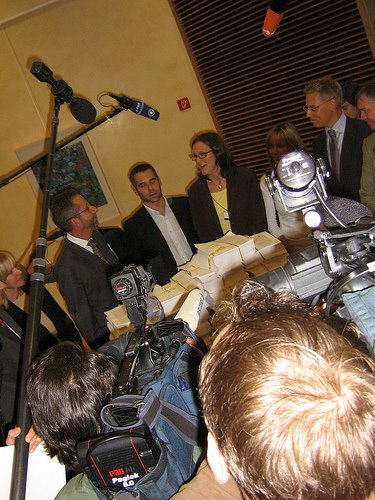
Today I walked with Cecilia Malmström and a small army of journalists to the Berlaymont to hand over one million signatures from European citizens to the EU Commission.
The hand-over was the final part of the Oneseat-campaign which aim was to gather a million signatures against the European Parliament's second seat in Strasbourg.
Unfortunately Margot Wallström was not able to attend since she is in Sweden due to a restructuring of her political party, the Swedish social democrats (they lost the recent national elections).
Malmström said at the press conference:
"The Strasbourg issue is something Europeans really care about. We hope people all over the EU will be inspired by this and take new citizens' initiatives"
With this I can only agree.
See more photos at flickr
It is still possible to sign on the webpage www.oneseat.eu
Tuesday, September 19, 2006
They didn't win...
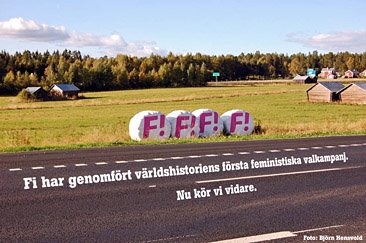
... but they made a statement!
The text on the picture says "Fi has completed the world's first feminist election campaign. Now we are moving on"
Fi is short for Feministiskt Initiativ, the feminist party in Sweden.
Monday, September 18, 2006
One million Europeans have signed against Strasbourg
Each year 200 million Euro are spend on moving the European Parliament between its two seats in Brussels and Strasbourg in France.
Today the European campaign 'Oneseat' reached its goal: one million Europeans have signed a petitition for a permanent seat in Brussels.
Now it will be interesting to see what will happen. The webpage of Cecilia Malmström (Swedish member of the parliament), who started the petition, explains:
"... when commissioner Margot Wallström said that she, in the framework of her plan D (for democracy, dialogue and debate), hopes to see a few citizens’ initiatives land at her desk, the idea of letting the Strasbourg issue become subject to a campaign started to grow. The citizen’s initiative, as described in the article 47 on participatory democracy in the proposed Constitution, allows for the EU citizens to become more active and to participate on European issues. If any petition collects one million signatures, the commission promises to raise the question. Mrs Wallström’s statement that she considers this initiative valid, independently of what happens to the constitution, is to be welcomed."
In spite of good will there is a limit to what Wallström can do. Legally, the Council of the European Union has the final say in the debate about Strasbourg. Meaning, it will be Europe's heads of states that will make the decision in the end. And whether they will be able to reach an agreement on the matter is doubtful. For sure Chirac will oppose the idea. Strasbourg is the symbol of peace between France and Germany and the seat is far to prestigious for the French to let go of it.
The monthly Strasbourg trips are a waste of time and money. Even a waste of space if you consider the suggestion that the Strasbourg building could accomodate a prominent pan-European university.
Today the European campaign 'Oneseat' reached its goal: one million Europeans have signed a petitition for a permanent seat in Brussels.
Now it will be interesting to see what will happen. The webpage of Cecilia Malmström (Swedish member of the parliament), who started the petition, explains:
"... when commissioner Margot Wallström said that she, in the framework of her plan D (for democracy, dialogue and debate), hopes to see a few citizens’ initiatives land at her desk, the idea of letting the Strasbourg issue become subject to a campaign started to grow. The citizen’s initiative, as described in the article 47 on participatory democracy in the proposed Constitution, allows for the EU citizens to become more active and to participate on European issues. If any petition collects one million signatures, the commission promises to raise the question. Mrs Wallström’s statement that she considers this initiative valid, independently of what happens to the constitution, is to be welcomed."
In spite of good will there is a limit to what Wallström can do. Legally, the Council of the European Union has the final say in the debate about Strasbourg. Meaning, it will be Europe's heads of states that will make the decision in the end. And whether they will be able to reach an agreement on the matter is doubtful. For sure Chirac will oppose the idea. Strasbourg is the symbol of peace between France and Germany and the seat is far to prestigious for the French to let go of it.
The monthly Strasbourg trips are a waste of time and money. Even a waste of space if you consider the suggestion that the Strasbourg building could accomodate a prominent pan-European university.
Sunday, September 17, 2006
Danish media are run by men
A report from the weekly newsletter A4 (published by The Danish Confederation of Trade Unions) reveals that more than half of Denmark's nationwide newspapers does not have a single woman in the editorial management. In spite the fact that 40 percent of the members of the Danish Journalist Union are female it is still to a very large extend men who are in power in the media business.
Media expert Rasmus Jønsson says to A4:
"It is a men's club of old friends who see things from the same perspective, move in the same circles, are raised by each other and have followed the same career path. The problem is not just that there is an overrepresentation of men - these men are also alike. And that has a consequence for the way they shape media."
Ask Rostrup, chief editor at MetroXpress (part of the Metro chain) seems to agree that more women are needed:
"It is about having the best blend of people because it reflects the society media are to describe. When you have to develop ideas it is a problem if everyone relate to the same reality."
Good point. Still Rostrup has hired two men as his closest colleagues. Both of them having worked as journalists at MetroXpress a long time before they were promoted - one even being Rostrup's old fellow student. And as with most other editorial positions the vacant jobs were never advertised. The editor-in-chief explains:
"They were both obvious candidates."
Key to better representation in the media business must be that editors begin to hire people that are not mirrored images of themselves. For example by recruiting from outside the "men's club".
This could also be an effective way of expanding readership. According to A4 consumers of newspapers are the same as those who produce them: Middle-aged men.
Media expert Rasmus Jønsson says to A4:
"It is a men's club of old friends who see things from the same perspective, move in the same circles, are raised by each other and have followed the same career path. The problem is not just that there is an overrepresentation of men - these men are also alike. And that has a consequence for the way they shape media."
Ask Rostrup, chief editor at MetroXpress (part of the Metro chain) seems to agree that more women are needed:
"It is about having the best blend of people because it reflects the society media are to describe. When you have to develop ideas it is a problem if everyone relate to the same reality."
Good point. Still Rostrup has hired two men as his closest colleagues. Both of them having worked as journalists at MetroXpress a long time before they were promoted - one even being Rostrup's old fellow student. And as with most other editorial positions the vacant jobs were never advertised. The editor-in-chief explains:
"They were both obvious candidates."
Key to better representation in the media business must be that editors begin to hire people that are not mirrored images of themselves. For example by recruiting from outside the "men's club".
This could also be an effective way of expanding readership. According to A4 consumers of newspapers are the same as those who produce them: Middle-aged men.
Saturday, September 16, 2006
Jane Fonda visits Swedish feminist party
"Come on, vote for the feminists!" said American movie and aerobic star Jane Fonda yesterday. She visited Sweden in connection with the national elections that will take place this Sunday and to give her support to the Swedish feminist party "Feministiskt initiativ".
It seems Jane Fonda has really understood what modern feminism is all about. She says to the Danish newspaper Politiken:
"To some the idea about a feministic party may appear threatening. But it is not about turning the patriarchy into a matriarchy. It is about turning the patriarchy into a democracy. That is what feminism represents."
At the moment, though, the Swedish feminist party is far from victory. They need 4 percent of the votes to enter the parliament. According to polls they are to get only 1 percent.
Go, F!
It seems Jane Fonda has really understood what modern feminism is all about. She says to the Danish newspaper Politiken:
"To some the idea about a feministic party may appear threatening. But it is not about turning the patriarchy into a matriarchy. It is about turning the patriarchy into a democracy. That is what feminism represents."
At the moment, though, the Swedish feminist party is far from victory. They need 4 percent of the votes to enter the parliament. According to polls they are to get only 1 percent.
Go, F!
Thursday, September 14, 2006
Famous feminist #4
 Merrill Beth Nisker (born 1968), better known as Peaches, is an electroclash artist. Her songs are mainly concerned with sex. Before she became "Peaches," she was an elementary school teacher and librarian.
She plays almost all the instruments for her songs, programs her own electronic beats and produces her records.Her songs have been featured in movies such as Mean Girls, My Little Eye and Lost in Translation. Her music has also been featured on Showtime's The L Word television series. Peaches performed guest vocals on Pink's album Try This, on the song "Oh My God." She has been invited to lecture at the Contemporary Music Academy in Berlin. Her most notorious song, "Fuck the Pain Away," is also the name of an electro night club in Brighton.
Peaches' music is preoccupied with gender identity. Her lyrics and live shows self-consciously blur the distinction between male and female; she appears on the cover of her second album Fatherfucker with a full beard. When asked if she had chosen the title for shock value, she commented:
"Why do we call our mothers motherfuckers? Why do we stub our toe and say, "Aww motherfucker!"? What is motherfucker? ... We use it in our everyday language, and it's such an insanely intense word. I'm not one to shy away from these obscene terms that we actually have in our mainstream. Motherfucker is a very mainstream word. But if we're going to use motherfucker, why don't we use fatherfucker? I'm just trying to be even."
She disputes accusations of "penis envy," preferring the term "hermaphrodite envy" since "there is so much male and female in us all." Nevertheless, she does not shy away from identifying herself as a sexual being, although she rejects the sanitized portrayal of women in popular music.
Source: wikipedia
This is a more controversial choice of 'famous feminist'. I chose Peaches because she gave a concert in Copenhagen yesterday. She must be crazy on stage (I've never seen her so I just imagine) but still cool. Politiken wrote in their review:
"It is an interesting, feministic style when this pale, chubby, not very attractive woman again and again in hotpants and bra exhibits her sexuality and appears strong and cool by doing so. You are fascinated and repelled at the same time. At times she looks like a nervous school girl, other times like an ugly transvestite. As she sings: "You love it when I'm bad" - and we do. Because she breaks our ideas about what a woman is and what she does and should do."
Wednesday, September 13, 2006
Mr. feminist
"The goal of a 'man book' is not to oppose gender equality or to create a manifesto against feminism. On the contrary the idea is to turn feminism into a joint project where both genders fight against gender roles and gender prejudices that for no good reasons keep us from living our lives as we wish. Such a feminism, that is also is a matter for men, will of course have to reflect men's experiences and perspectives as well as it reflects those of women. Such a feminism will have to break female feminists' monopoly power over interpreting gender and gender roles."
- Danish author Niels Ulrik Sørensen in the antology 'Pikstormerne' (2000).
- Danish author Niels Ulrik Sørensen in the antology 'Pikstormerne' (2000).
Sunday, September 10, 2006
Danish sex photographer II
A new kind of journalism is thriving in Denmark.
"The media is the new court system and you're the judge!" as stagisblog puts it.
Morten Spiegelhauer and his programme "Operation X" is a good example of journalism that turns your living room into a court. Two weeks ago he revealed the sex crimes of a 'paedophile hunter', effectively collecting evidence and doing interrogation on-screen. Afterwards all footage was handed over to the police who then - rather undramatic - arrested the suspect. What the real-life court has to say will not really matter. Rudy Frederiksen has already recieved his verdict. All those who followed Spiegelhauer's investigation from the sofa have delivered their sentence: guilty.
The thing I have most against "Operation X" is its moralism. One thing is to uncover illegal acts or immoral deeds. Another is to expose the guilt of the perpetrators into endless details. In an earlier episode of "Operation X" Spiegelhauer took a close look at trafficking and sex slavery in Denmark. Here he confronted a pimp with the immorality of sex trade by repeatly asking questions resembling "how can you bring yourself to profit on sex slavery?"
I find this kind of 'moral porn' repulsive. We all know that it is wrong to exploit other people and that there are very few morally acceptable motives for doing so. Why do we need this pillary in prime time?
"The media is the new court system and you're the judge!" as stagisblog puts it.
Morten Spiegelhauer and his programme "Operation X" is a good example of journalism that turns your living room into a court. Two weeks ago he revealed the sex crimes of a 'paedophile hunter', effectively collecting evidence and doing interrogation on-screen. Afterwards all footage was handed over to the police who then - rather undramatic - arrested the suspect. What the real-life court has to say will not really matter. Rudy Frederiksen has already recieved his verdict. All those who followed Spiegelhauer's investigation from the sofa have delivered their sentence: guilty.
The thing I have most against "Operation X" is its moralism. One thing is to uncover illegal acts or immoral deeds. Another is to expose the guilt of the perpetrators into endless details. In an earlier episode of "Operation X" Spiegelhauer took a close look at trafficking and sex slavery in Denmark. Here he confronted a pimp with the immorality of sex trade by repeatly asking questions resembling "how can you bring yourself to profit on sex slavery?"
I find this kind of 'moral porn' repulsive. We all know that it is wrong to exploit other people and that there are very few morally acceptable motives for doing so. Why do we need this pillary in prime time?
Danish sex photographer I
Recently a Danish 'paedophile hunter', a was revealed as a sex photographer of young girls. Rudy Frederiksen worked as a school consultant and was one of Danish media's most used experts in paedophilia. The Danish TV programme 'Operation X' exposed his "side business"; recording and selling videos of himself having sex with girls younger than 18.
Rudy Frederiksen found the girls he had sex with on the web. He promised them careers as models and they agreed to meet, have sex with him and have the act filmed. But why on earth would they say yes to do a sex video with a 40-year-old man? Why is there some (very) young girls who accept such sex offers when they appear to be easy to refuse? After all - it is just typing in "no thanks!" on the keyboard. In Information (9-9-2006) Kuno Sørensen from Save the Children Denmark gives an explanation:
"The young girls are part of a culture where the physical plays an important role. Here the chat rooms - where they use their profiles to exhibit themselves - is part of generating a competition that might pressure the girls to go overstep their boundaries."
Another expert, Anna Lynge, says:
"It is difficult for the girls to say no because it is an unknown and exciting territory that they are entering. At the same time they naively trust that adults know what they are doing. And then it should not be underestimated that it is attractive to get attention and compliments from a grown-up man if you are 13-15 years old."
"At the same time there is a lot of focus on being the most sexy and daring. The most beautiful. That is what many TV-shows are about. It is a competition about getting attention by exhibiting yourself."
Sadly, sexuality has - not just for women but also for very young girls - become a very dominant 'tool' to achieve social accept. This is what paves the way for sex offenders as Rudy Frederiksen.
Rudy Frederiksen found the girls he had sex with on the web. He promised them careers as models and they agreed to meet, have sex with him and have the act filmed. But why on earth would they say yes to do a sex video with a 40-year-old man? Why is there some (very) young girls who accept such sex offers when they appear to be easy to refuse? After all - it is just typing in "no thanks!" on the keyboard. In Information (9-9-2006) Kuno Sørensen from Save the Children Denmark gives an explanation:
"The young girls are part of a culture where the physical plays an important role. Here the chat rooms - where they use their profiles to exhibit themselves - is part of generating a competition that might pressure the girls to go overstep their boundaries."
Another expert, Anna Lynge, says:
"It is difficult for the girls to say no because it is an unknown and exciting territory that they are entering. At the same time they naively trust that adults know what they are doing. And then it should not be underestimated that it is attractive to get attention and compliments from a grown-up man if you are 13-15 years old."
"At the same time there is a lot of focus on being the most sexy and daring. The most beautiful. That is what many TV-shows are about. It is a competition about getting attention by exhibiting yourself."
Sadly, sexuality has - not just for women but also for very young girls - become a very dominant 'tool' to achieve social accept. This is what paves the way for sex offenders as Rudy Frederiksen.
Friday, September 01, 2006
Save me from the baboons
I found a couple of interesting quotes in a commentary in yesterday's edition of the new free Danish daily Dato (collected during a really quick trip to Denmark!). Journalist Esben Kjær comments on a feature in Berlingske: "Feminine values killed the alpha-male" (28th of August 2006). Judging from the headline my spontanious and honest response is to agree with Kjær (he labels it "childish bollocks") but I will read the article more thoroughly later and maybe give a comment. For now I see it mostly as another example that we need a far more nuanced debate about gender roles in Denmark.
But let me pass on two of Kjær's interesting points about gender roles:
"First and foremost women have not made any coups. They have fought openly for equality and modern femininity for almost 40 years - and with great success. Meanwhile the man has more or less done nothing to define a similiar masculine project. So if the women set the agenda then it is the fault of the men - the gender that is presumed to be capable of decisive action. Men need to give word to what the modern man believes..."
"Secondly: men are not 'womanish' ('kvindagtig' in Danish) just because they do not walk around and beat their chests. Because while the women have be talking - and as we know they are pretty good at that - men have been doing what they are good at: acting. Author Bertill Nordahl [...] speaks of a new, masculine identity that builds on more than career. The modern man is an engaged, (almost) equal father - in his own way. He flirts with the feminine (as liberated women flirt with the masculine), is body-conscious and vain, with broad shoulders and a determined look. A many-sided masculinity that we have never before seen so many men have in society."
But let me pass on two of Kjær's interesting points about gender roles:
"First and foremost women have not made any coups. They have fought openly for equality and modern femininity for almost 40 years - and with great success. Meanwhile the man has more or less done nothing to define a similiar masculine project. So if the women set the agenda then it is the fault of the men - the gender that is presumed to be capable of decisive action. Men need to give word to what the modern man believes..."
"Secondly: men are not 'womanish' ('kvindagtig' in Danish) just because they do not walk around and beat their chests. Because while the women have be talking - and as we know they are pretty good at that - men have been doing what they are good at: acting. Author Bertill Nordahl [...] speaks of a new, masculine identity that builds on more than career. The modern man is an engaged, (almost) equal father - in his own way. He flirts with the feminine (as liberated women flirt with the masculine), is body-conscious and vain, with broad shoulders and a determined look. A many-sided masculinity that we have never before seen so many men have in society."
Monday, August 28, 2006
The need for a new concept of masculinity
"Men are the loosers of the future" states a big headline in today's edition of the Danish newspaper Politiken.
According to the Economic Council of the Labour Movement the Danish labour market will lack 136.000 skilled workers and 66.000 persons with a higher education in 2015. In turn there will be 135.000 unskilled workers in surplus.
"It will be men who will be in trouble," says managing director Lars Andersen from the Economic Council of the Labour Movement. There is a big difference between the educational pattern of men and women: Today half of Denmark's young women goes for higher education whereas only 37 percent of the young men has chosen university or the like. He explains:
"The young women's educational profile is a better fit for the future's labour market than that of the men. The men are in high risk of becoming the future's loosers."
This is sad news. There are of course no good biological reasons for men to have less motivation for higher education than women - so something must be very wrong with the way that men are taught to be men.
The new report is just another proof how crucial it is that we escape traditional gender roles and reinvent what it means to be 'a man' and 'a woman'.
According to the Economic Council of the Labour Movement the Danish labour market will lack 136.000 skilled workers and 66.000 persons with a higher education in 2015. In turn there will be 135.000 unskilled workers in surplus.
"It will be men who will be in trouble," says managing director Lars Andersen from the Economic Council of the Labour Movement. There is a big difference between the educational pattern of men and women: Today half of Denmark's young women goes for higher education whereas only 37 percent of the young men has chosen university or the like. He explains:
"The young women's educational profile is a better fit for the future's labour market than that of the men. The men are in high risk of becoming the future's loosers."
This is sad news. There are of course no good biological reasons for men to have less motivation for higher education than women - so something must be very wrong with the way that men are taught to be men.
The new report is just another proof how crucial it is that we escape traditional gender roles and reinvent what it means to be 'a man' and 'a woman'.
Sunday, August 27, 2006
Famous feminist #3
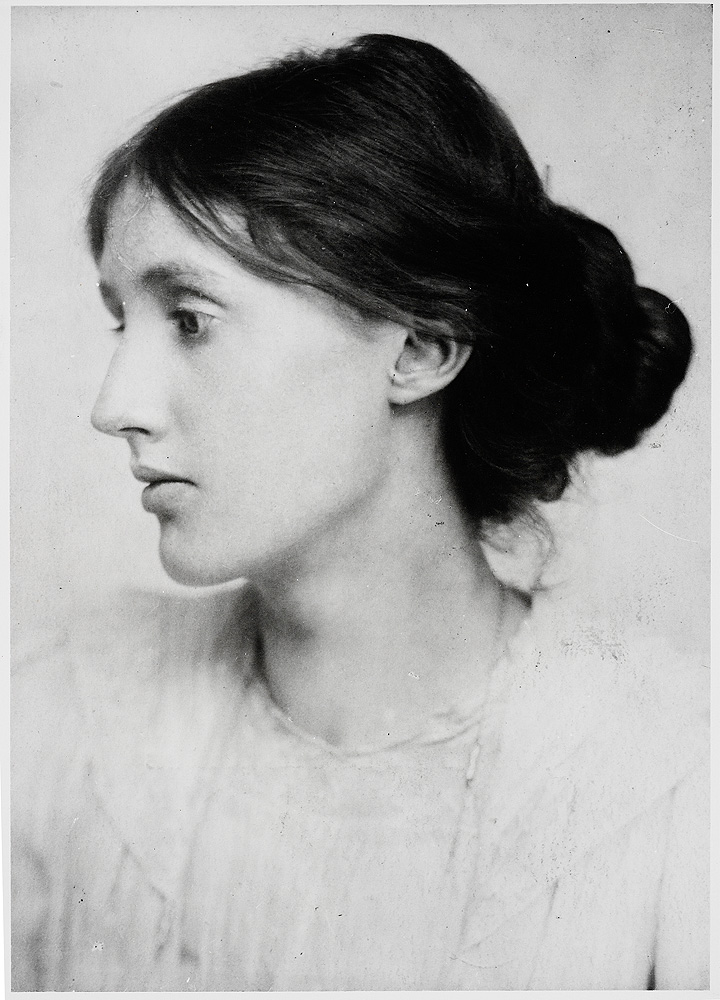 "Have you any notion how many books are written about women in the course of one year? Have you any notion how many are written by men? Are you aware that you are, perhaps, the most discussed animal in the universe?"
Virginia Woolf (1882-1941) is a British author who made an original contribution to the form of the novel - also distinguished feminist essayist, critic in The Times Literary Supplement, and a central figure of Bloomsbury group.
Virginia Woolf's concern with feminist thematics are dominant in "A room of one's own" (1929). In it she made her famous statement: "A woman must have money and a room of her own if she is to write fiction." The book originated from two expanded and revised lectures the author presented at Cambridge University's Newnham and Girton Colleges in October 1928. Woolf examined the obstacles and prejudices that have hindered women writers. She separated women as objects of representation and women as authors of representation, and argued that a change in the forms of literature was necessary because most literature had been "made by men out of their own needs for their own uses." In the last chapter Woolf touched the possibility of an androgynous mind. Woolf refers to Coleridge who said that a great mind is androgynous and states that when this fusion takes place the mind is fully fertilized and uses all its faculties. "Perhaps a mind that is purely masculine cannot create, any more than a mind that is purely feminine..." 'Three guineas' (1938) urged women to make a claim for their own history and literature.
Source: kirjasto.sci.fi
Saturday, August 26, 2006
I'd rather be a Cyborg than a goddess
 What you are about to read is really a curiosity.
Last year I stumbled over the notion of "cyber feminism". American Professor Donna Haraway is the woman behind the remarkable 'ism' and the idea is that feminists and women should consider that machines can contribute to liberation and close the gender gap. She writes:
“Up till now (once upon a time), female embodiment seemed to be given, organic, necessary; and female embodiment seemed to mean skill in mothering and its metaphoric extensions. Only by being out of place could we take intense pleasure in machines, and then with excuses that this was organic activity after all, appropriate to females”
Read more in Haraway's cyborg manifesto
Thursday, August 24, 2006

Wednesday, August 23, 2006
My inner European
Speaking of European integration.
| Your Inner European is Dutch! |
 |
The heart of Europe
I just spent two great days in Amsterdam where I met up with my fellow students from the Erasmus Mundus programme. I haven't seen them for almost two months so I was of course really glad to be reunited.
After a couple of days of relaxation in one of my favourite European cities I moved on to Brussels where I will stay for about a month to do an internship. I have been wanting to work in Brussels for a looong time so I am quite excited to start tomorrow.
Before leaving Amsterdam one of my friends there asked me if I was an Euro-skeptic. My spontanious answer was 'no'. I have never really been that skeptic about the EU and European integration. I guess I am something as rare as an Euro-optimist.
From today I am an Euro-optimist in EU-land.
After a couple of days of relaxation in one of my favourite European cities I moved on to Brussels where I will stay for about a month to do an internship. I have been wanting to work in Brussels for a looong time so I am quite excited to start tomorrow.
Before leaving Amsterdam one of my friends there asked me if I was an Euro-skeptic. My spontanious answer was 'no'. I have never really been that skeptic about the EU and European integration. I guess I am something as rare as an Euro-optimist.
From today I am an Euro-optimist in EU-land.
Monday, August 14, 2006
Famous feminist #2
 Shirin Neshat was born in Iran in 1957, and presently lives and works in New York. The way in which she gives form to her theme makes the tensions between her original background and Western culture visible.
When she was 17 Shirin Neshat moved from the land of her birth to Los Angeles, to begin her studies at an art academy. The Iranian Revolution broke out while she was in the United States, and Ayatollah Khomeini came to power. Under his regime women were required to wear the chador. Sixteen years later, in 1990 she revisited her fatherland for the first time. This renewed acquaintance made deep impression on her.
Since then Neshat focused on investigating and commenting on her relation to her homeland and Islam, and in particular the position of women and male/female relationships. For this she draws on two very different cultural backgrounds, using their insights to examine large, underlying social themes.
Source: Stedelijk Museum, Amsterdam
Zarin, 2005 (video) 
Passage, 2001 (video)
The Last Word, 2003 (video)
Thursday, August 10, 2006
Famous feminist #1

Simone de Beauvoir (January 9, 1908 – April 14, 1986) was a French author and philosopher. She is best known for her 1949 treatise Le Deuxième Sexe (The Second Sex), a detailed analysis of women's oppression and a foundational tract of contemporary feminism.
As an existentialist, de Beauvoir accepts the precept that existence precedes essence; hence one is not born a woman, but becomes one. Her analysis focuses on the concept of The Other. It is the (social) construction of Woman as the quintessential Other that de Beauvoir identifies as fundamental to women's oppression.
De Beauvoir argues that women have historically been considered deviant, abnormal. She says that this attitude has limited women's success by maintaining the perception that they are a deviation from the normal, and are outsiders attempting to emulate "normality". For feminism to move forward, this assumption must be set aside.
De Beauvoir asserted that women are as capable of choice as men, and thus can choose to elevate themselves, reducing male consciousness to immanence.
Source: Wikipedia.org
Monday, August 07, 2006
Paternal leave
Today the free Danish daily MetroXpress featured a story about parental leave.
"There is a trend towards fathers getting harassed if they express their desire to take parental leave. We have heard about reactions as 'you can forget all about it' and 'your wife can do that, not you'," says Jane Korczak fra 3F, the biggest Danish trade union.
According to 3F and other trade unions many fathers even get sacked by their employers if they wish to take parental leave.
By Danish law fathers have the option to to take 32 weeks of the total parental leave - but it is only a possibility, not a right.
This is a truly unsatisfying situation for both men and women. Fathers should have the right to take half of the leave - just as mothers should have the right not to take it. Come on, politicians - help the families and earmark half of the parental leave for the father.
"There is a trend towards fathers getting harassed if they express their desire to take parental leave. We have heard about reactions as 'you can forget all about it' and 'your wife can do that, not you'," says Jane Korczak fra 3F, the biggest Danish trade union.
According to 3F and other trade unions many fathers even get sacked by their employers if they wish to take parental leave.
By Danish law fathers have the option to to take 32 weeks of the total parental leave - but it is only a possibility, not a right.
This is a truly unsatisfying situation for both men and women. Fathers should have the right to take half of the leave - just as mothers should have the right not to take it. Come on, politicians - help the families and earmark half of the parental leave for the father.
Sunday, August 06, 2006
Let us move beyond the sex and beauty stuff
After a fun night out with some good friends I stumbled over a stack of free gay&les magazines. With usual curiosity and my fetish for printed things (magazines, leaflets, brochures, posters... you name it, I'll grab it!) I took a copy with me home. After a long night in town I passed out instantly and forgot all about the magazine until my hangover was gone the next day.
But then... it was really an interesting reader! Besides the theme "what is queer?" which was one of the reasons the magazine appealed to me in the first place (my growing feminist awareness have led me to be interested in the notion of 'queer') it was really nice to experience how political it was. These people have their sexual orientation in common, but the publication was not all about sex and how to be attractive - thank god NO!
It made me think about how utterly dull women's magazines are. We lack to see equal pay, women are significally underrepresented in top management and only 1 percent of the world's property is owned by women but still the seven or eight magazines for women we have in Denmark all write about the same things: sex, relationships, the newest self-help books, interior decoration and beauty tips. Isn't it time to try out something new?
Be political!
But then... it was really an interesting reader! Besides the theme "what is queer?" which was one of the reasons the magazine appealed to me in the first place (my growing feminist awareness have led me to be interested in the notion of 'queer') it was really nice to experience how political it was. These people have their sexual orientation in common, but the publication was not all about sex and how to be attractive - thank god NO!
It made me think about how utterly dull women's magazines are. We lack to see equal pay, women are significally underrepresented in top management and only 1 percent of the world's property is owned by women but still the seven or eight magazines for women we have in Denmark all write about the same things: sex, relationships, the newest self-help books, interior decoration and beauty tips. Isn't it time to try out something new?
Be political!
Friday, August 04, 2006
Imagine Bush
 'Imagine this' is an audio mash up of president Bush singing the John Lennon hit 'Imagine'.
Just imagine.
Tuesday, July 18, 2006
My kind of place
 It has been a while since my last post but I have spend the last weeks on moving to Denmark and getting in place for the summer. Until the 1st of August I will be vacating at a friend's place and looking at her humourous choice of bathroom decoration I already feel at home.
(For foreign readers I can inform that the picture is of Pia Kjaersgaard, the leader of the Danish People's Party)
Wednesday, June 21, 2006
Holiday brainfood


Humorous Muslims
Farshad Kholghi, Danish actor and debater (born in Iran), had an interesting column in Berlingske Tidende this Monday. Funny, thought-provoking or just utterly offensive? I can't really decide.
Farshad Kholghi: Humorous Muslims
Do we need a new organization: "Humorous Muslims"?
There are countless Muslim organizations such as Critical Muslims, Less Critical Muslims, Absolutely Uncritical Muslims, European Muslims, Communist Muslims, the Danish Socioliberal Party, Vegetarian Muslims og now also Democratic Muslims.
Common for all of them is that they have an urgent need to underscore the name of their religion. For example: Democratic Muslims. Is it not possible to form an association simply called "the Democrats", where there is room for everyone who has a democratic mind?
There are no organizations called "Democratic citizens of Bornholm", or "Critical Homosexuals" or "Tantric Rockers".
[...]
Now the time has come to form a new Muslim organization. If God created everything on earth he must also have created humour, satire, self-irony, self-examination and the self-critical way of thinking. Therefore these ideas must be holy.
Since I am not Muslim myself I will simply pass on the idea so others can found the association:
objects clause:
1- to spread out self-irony and self-critique in the Muslim faith.
2- to go through the faith and clean it for quotes or passages that say "kill them whereever you find them" or similar urgings to killing and violence that can be abused by terrorists.
3- to learn to recognize own mistakes. Only by laughing at them you can win the hearts of others and reform old ideas.
4- to encourage all members to draw caricatures [...] or write self-critical or self-ironical stories that can challenge and move own borders. You cannot achieve the divine if you never transgress your own limits and renew your faith.
5- the new organization will be called "Humorous Muslims".
If you are not offended by the above-mentioned and do not feel urge to set buildings or flags on fire you are automatically a member of Humorous Muslims.
Congratulations
(Berlingske Tidende, 19-06-2006, my translation from Danish)
Read the full article here
Farshad Kholghi: Humorous Muslims
Do we need a new organization: "Humorous Muslims"?
There are countless Muslim organizations such as Critical Muslims, Less Critical Muslims, Absolutely Uncritical Muslims, European Muslims, Communist Muslims, the Danish Socioliberal Party, Vegetarian Muslims og now also Democratic Muslims.
Common for all of them is that they have an urgent need to underscore the name of their religion. For example: Democratic Muslims. Is it not possible to form an association simply called "the Democrats", where there is room for everyone who has a democratic mind?
There are no organizations called "Democratic citizens of Bornholm", or "Critical Homosexuals" or "Tantric Rockers".
[...]
Now the time has come to form a new Muslim organization. If God created everything on earth he must also have created humour, satire, self-irony, self-examination and the self-critical way of thinking. Therefore these ideas must be holy.
Since I am not Muslim myself I will simply pass on the idea so others can found the association:
objects clause:
1- to spread out self-irony and self-critique in the Muslim faith.
2- to go through the faith and clean it for quotes or passages that say "kill them whereever you find them" or similar urgings to killing and violence that can be abused by terrorists.
3- to learn to recognize own mistakes. Only by laughing at them you can win the hearts of others and reform old ideas.
4- to encourage all members to draw caricatures [...] or write self-critical or self-ironical stories that can challenge and move own borders. You cannot achieve the divine if you never transgress your own limits and renew your faith.
5- the new organization will be called "Humorous Muslims".
If you are not offended by the above-mentioned and do not feel urge to set buildings or flags on fire you are automatically a member of Humorous Muslims.
Congratulations
(Berlingske Tidende, 19-06-2006, my translation from Danish)
Read the full article here
Monday, June 19, 2006
The postmodernism generator
Ever wonder what that illusive postmodernism is about? Sorry, but this post will not be helpful in figuring that out.
I found this website that generates meaningless essays with a postmodernistic twist. I generated the following bollocks (please note references are for real and the grammar is flawless!):
-------------------------------------
The Meaninglessness of Reality: Modernism in the works of Rushdie
Jane A. Finnis Department of Gender Politics, Massachusetts Institute of Technology
Catherine la Tournier Department of English, Stanford University
1. Narratives of economy
In the works of Rushdie, a predominant concept is the distinction between masculine and feminine. Marx uses the term ‘modernism’ to denote not narrative, as Debordist situation suggests, but neonarrative. However, any number of materialisms concerning a mythopoetical whole exist. If subtextual nationalism holds, the works of Rushdie are modernistic. Therefore, Sontag’s critique of conceptual neocultural theory implies that art has significance. The main theme of Long’s[1] analysis of Debordist situation is the collapse, and some would say the paradigm, of modern society. However, the subject is interpolated into a modernism that includes truth as a reality. Many discourses concerning Debordist situation may be found.
2. Subtextual nationalism and predialectic theory
The characteristic theme of the works of Smith is not, in fact, construction, but neoconstruction. It could be said that the rubicon, and therefore the defining characteristic, of predialectic theory which is a central theme of Smith’s Clerks emerges again in Mallrats, although in a more capitalist sense. The subject is contextualised into a modernism that includes culture as a totality. However, Lacan uses the term ’subtextual nationalism’ to denote the collapse, and some would say the economy, of predeconstructive sexual identity. Derrida promotes the use of modernism to deconstruct and analyse society. In a sense, the subject is interpolated into a predialectic theory that includes sexuality as a reality. Dahmus[2] holds that we have to choose between neomaterial dialectic theory and subcapitalist discourse.
3. Consensuses of dialectic
“Culture is meaningless,” says Sontag; however, according to Porter[3] , it is not so much culture that is meaningless, but rather the economy, and eventually the futility, of culture. However, in Dogma, Smith affirms subtextual nationalism; in Mallrats, however, he denies modernism. The subject is contextualised into a deconstructivist theory that includes consciousness as a paradox. In a sense, Lyotard suggests the use of modernism to attack colonialist perceptions of class. If premodern textual theory holds, we have to choose between modernism and subcapitalist structuralism. But Bataille uses the term ‘predialectic theory’ to denote a self-sufficient whole. Pickett[4] states that we have to choose between modernism and the textual paradigm of discourse. Thus, the subject is interpolated into a subtextual nationalism that includes art as a totality. The primary theme of Pickett’s[5] essay on Sontagist camp is not theory, but posttheory.
1. Long, N. V. ed. (1991) Subtextual nationalism in the works of Smith. University of California Press
2. Dahmus, G. (1976) Expressions of Genre: Subtextual nationalism and modernism. University of Massachusetts Press
3. Porter, Y. Q. G. ed. (1993) Modernism in the works of Cage. Harvard University Press
4. Pickett, B. (1977) The Forgotten Sea: Subtextual nationalism in the works of Joyce. Oxford University Press
5. Pickett, V. P. C. ed. (1984) Capitalism, modernism and precapitalist Marxism. O’Reilly & Associates
-------------------------------------
I found this website that generates meaningless essays with a postmodernistic twist. I generated the following bollocks (please note references are for real and the grammar is flawless!):
-------------------------------------
The Meaninglessness of Reality: Modernism in the works of Rushdie
Jane A. Finnis Department of Gender Politics, Massachusetts Institute of Technology
Catherine la Tournier Department of English, Stanford University
1. Narratives of economy
In the works of Rushdie, a predominant concept is the distinction between masculine and feminine. Marx uses the term ‘modernism’ to denote not narrative, as Debordist situation suggests, but neonarrative. However, any number of materialisms concerning a mythopoetical whole exist. If subtextual nationalism holds, the works of Rushdie are modernistic. Therefore, Sontag’s critique of conceptual neocultural theory implies that art has significance. The main theme of Long’s[1] analysis of Debordist situation is the collapse, and some would say the paradigm, of modern society. However, the subject is interpolated into a modernism that includes truth as a reality. Many discourses concerning Debordist situation may be found.
2. Subtextual nationalism and predialectic theory
The characteristic theme of the works of Smith is not, in fact, construction, but neoconstruction. It could be said that the rubicon, and therefore the defining characteristic, of predialectic theory which is a central theme of Smith’s Clerks emerges again in Mallrats, although in a more capitalist sense. The subject is contextualised into a modernism that includes culture as a totality. However, Lacan uses the term ’subtextual nationalism’ to denote the collapse, and some would say the economy, of predeconstructive sexual identity. Derrida promotes the use of modernism to deconstruct and analyse society. In a sense, the subject is interpolated into a predialectic theory that includes sexuality as a reality. Dahmus[2] holds that we have to choose between neomaterial dialectic theory and subcapitalist discourse.
3. Consensuses of dialectic
“Culture is meaningless,” says Sontag; however, according to Porter[3] , it is not so much culture that is meaningless, but rather the economy, and eventually the futility, of culture. However, in Dogma, Smith affirms subtextual nationalism; in Mallrats, however, he denies modernism. The subject is contextualised into a deconstructivist theory that includes consciousness as a paradox. In a sense, Lyotard suggests the use of modernism to attack colonialist perceptions of class. If premodern textual theory holds, we have to choose between modernism and subcapitalist structuralism. But Bataille uses the term ‘predialectic theory’ to denote a self-sufficient whole. Pickett[4] states that we have to choose between modernism and the textual paradigm of discourse. Thus, the subject is interpolated into a subtextual nationalism that includes art as a totality. The primary theme of Pickett’s[5] essay on Sontagist camp is not theory, but posttheory.
1. Long, N. V. ed. (1991) Subtextual nationalism in the works of Smith. University of California Press
2. Dahmus, G. (1976) Expressions of Genre: Subtextual nationalism and modernism. University of Massachusetts Press
3. Porter, Y. Q. G. ed. (1993) Modernism in the works of Cage. Harvard University Press
4. Pickett, B. (1977) The Forgotten Sea: Subtextual nationalism in the works of Joyce. Oxford University Press
5. Pickett, V. P. C. ed. (1984) Capitalism, modernism and precapitalist Marxism. O’Reilly & Associates
-------------------------------------
Sunday, June 18, 2006
Meta meta meta
Coverage of Danish politics has never been as 'meta-' as it is today. 10 years ago spin doctors were never mentioned in the news. Last year .2.353 articles adressed spin doctors and their deeds. 
Source: Kommunikationsforum
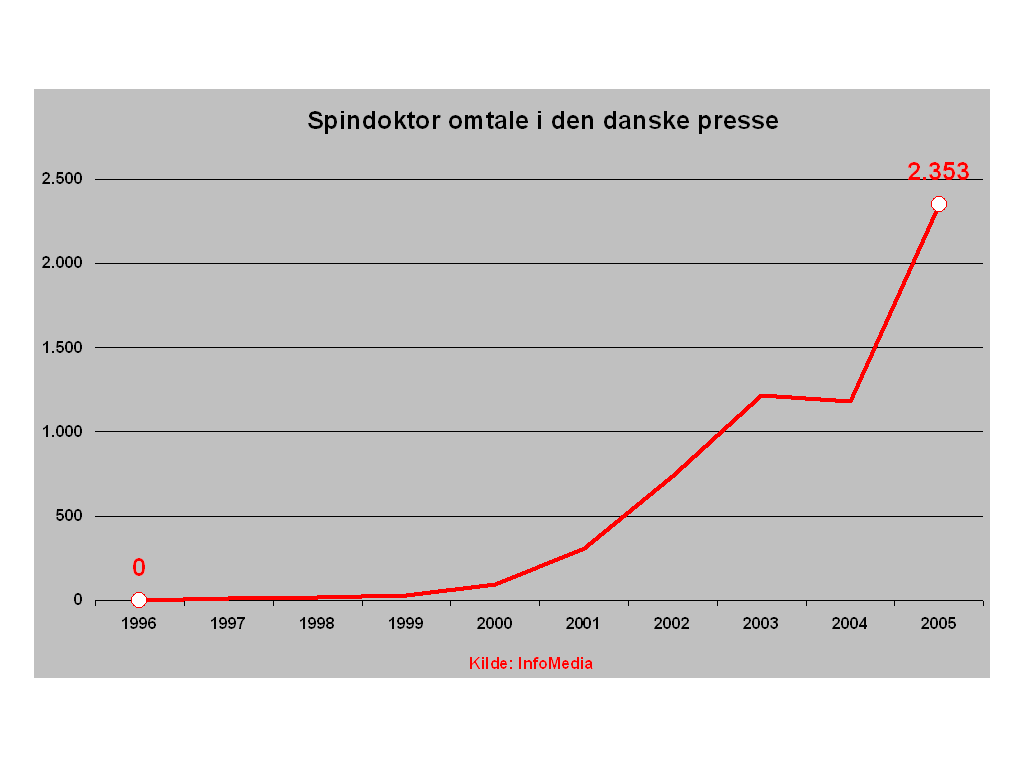
Source: Kommunikationsforum
Wednesday, June 14, 2006
Hvorfor er der så få kvindelige, politiske bloggere?
Input søges! Spørgsmålet er helt enkelt overskriften på dette post:
Hvorfor er der så få kvindelige, politiske bloggere i Danmark?
Mand eller kvinde, politisk blogger eller ej, rød, blå eller midtimellem - lad mig høre, hvad du synes og hjælp mig i jagten på det gyldne svar.
Spørgsmålet stilles i forbindelse med en universitetsopgave om politisk blogging i Danmark. Glæder mig til at høre jeres holdninger.
Hvorfor er der så få kvindelige, politiske bloggere i Danmark?
Mand eller kvinde, politisk blogger eller ej, rød, blå eller midtimellem - lad mig høre, hvad du synes og hjælp mig i jagten på det gyldne svar.
Spørgsmålet stilles i forbindelse med en universitetsopgave om politisk blogging i Danmark. Glæder mig til at høre jeres holdninger.
Wednesday, June 07, 2006
Feminists say 'goodbye neo-liberalism'
It seems to be a common perception that feminism is all about women liberating women. Sure, I understand why many would see things from this perspective - especially given the name of the 'ism' and the frequent talk about breaking down the patriarchal structures of society (which the author of this blog also contribute to).
But there is a more contemporary way of understanding feminism; feminism is about closing the gender gap and hereby liberating both men and women. Feminism is also about men's rights and giving men access to the domains that traditionally have belonged to women. In that sense fathers rights, securing men the same parental rights as women, is also an important aspect of feminism.
Personally, my preferred way of understanding feminism is even broader; feminism is about liberation and equality. Not only in terms of gender but also in relation to ethnicity, social class and age. I agree very much with Swedish feminist Tiina Rosenberg when she sees feminism as a part of a 'new left' movement in Europe:
"My vision of the Feminist Initiative was to put an end to neo-liberal politics. Here, I thought, is a need for left-wing feminists who say - no! We have insight in how gender works in society, but also in other structures such as class, ethnicity, race, homofobia, and we need to stop neo-liberalism. Just look at Paris - the suburbs are burning." (Weekendavisen, 20-1-2006, my translation from Danish)
But there is a more contemporary way of understanding feminism; feminism is about closing the gender gap and hereby liberating both men and women. Feminism is also about men's rights and giving men access to the domains that traditionally have belonged to women. In that sense fathers rights, securing men the same parental rights as women, is also an important aspect of feminism.
Personally, my preferred way of understanding feminism is even broader; feminism is about liberation and equality. Not only in terms of gender but also in relation to ethnicity, social class and age. I agree very much with Swedish feminist Tiina Rosenberg when she sees feminism as a part of a 'new left' movement in Europe:
"My vision of the Feminist Initiative was to put an end to neo-liberal politics. Here, I thought, is a need for left-wing feminists who say - no! We have insight in how gender works in society, but also in other structures such as class, ethnicity, race, homofobia, and we need to stop neo-liberalism. Just look at Paris - the suburbs are burning." (Weekendavisen, 20-1-2006, my translation from Danish)
Sunday, May 28, 2006
The Code decoded
This week I saw the (in-)famous movie The Da Vinci Code.
My judgement is...
..I really enjoyed it! To me appropriate measures of suspense, mystique and some interesting commentary.
As far as I understand a major the points of the movie is that Christianity is a construction made to distribute power in a certain way in society. Priests and kings in ancient times agreed upon the stories of Christianity so they would serve their interests the best. Hereby a society with significant inequalities between ethnicities, genders and social classes was created. Something that we - according to the movie - still see very much today. To put it crudely; Christianity is (another) tool for white men to remain those in power.
For many The Da Vince Code have raised the question if Christians are living a lie. But to me it is equally interesting to ask whether Christianity - at the end of the day - really is compatible with democracy?
My judgement is...
..I really enjoyed it! To me appropriate measures of suspense, mystique and some interesting commentary.
As far as I understand a major the points of the movie is that Christianity is a construction made to distribute power in a certain way in society. Priests and kings in ancient times agreed upon the stories of Christianity so they would serve their interests the best. Hereby a society with significant inequalities between ethnicities, genders and social classes was created. Something that we - according to the movie - still see very much today. To put it crudely; Christianity is (another) tool for white men to remain those in power.
For many The Da Vince Code have raised the question if Christians are living a lie. But to me it is equally interesting to ask whether Christianity - at the end of the day - really is compatible with democracy?
Thursday, May 18, 2006
Sometimes statistics say more than words
Women | Men | |
Share of world property | 1% | 99% |
Working hours/ income | 60% (hours); 10% (income) | 40% 90% |
Illiterates/ refugees | 60% (I) 80% (R) | 40% 20% |
via Mig og Verden (my translation from Swedish)
Sunday, May 14, 2006
Go youth!
I am truly sorry that I can't joint the demos in Denmark this Wednesday. In spite I don't agree with their take on early retirement benefit I still wish 17.maj-initiativet the best of luck with their events around the country. It is really cool to see so many different youth organizations cooperating. Thumbs up!
Friday, May 12, 2006
100 years ago
“I have a mother, and I have a wife and a sister and daughters, and I wish to continue in the position of their supporter and their protector, and not to place them under the necessity of protecting their own political position. I do not wish them to have extended to them the right not only to vote, but to sit in this Chamber. It is man's duty to be here, and it is woman's duty to attend to the family.”
William Knox in an Australian House of Assembly debate, 1902.
William Knox in an Australian House of Assembly debate, 1902.
Friday, May 05, 2006
One of our neighbours has a point
"I get really angry when I look at Sweden today. [...] Just look at Paris - the suburbs are burning. The immigrants live in the horrible, ghettoized suburbs where the houses are collapsing. In Sweden you see that the barriers of class increase. We are not talking about industrial workers, because soon we won't have any industry, but instead we have many proletarized fugitive and immigrant groups. Single parents, predominantly women. Those are the new-poor in Europe."
- Tiina Rosenberg, co-founder of the Swedish feminist party "Feministiskt Initiativ".
- Tiina Rosenberg, co-founder of the Swedish feminist party "Feministiskt Initiativ".
Friday, April 21, 2006

Friday, April 07, 2006
A video greeting
Yes, what do you want to know, Anders Fogh?
...what I think about your welfare reform? You mean this anti-youth project where my parents' generation runs clear and leaves the bill for their children? Well, I put it in a video for you. Enjoy.
...what I think about your welfare reform? You mean this anti-youth project where my parents' generation runs clear and leaves the bill for their children? Well, I put it in a video for you. Enjoy.
Wednesday, April 05, 2006
And I feel the whip
I wonder how the huge group of Danish students that voted for our governmental parties feel when they think about the government's upcoming welfare reform.
Is it something like this?
I tell you I love you
And I always will
And I know that you can't tell me
So I'm left to pick up
The hints, the little symbols of your devotion
I feel your fists
And I know it's out of love
And I feel the whip
And I know it's out of love
I feel your burning eyes burning holes
Straight through my heart
It's out of love
- Antony and the Johnsons
Is it something like this?
I tell you I love you
And I always will
And I know that you can't tell me
So I'm left to pick up
The hints, the little symbols of your devotion
I feel your fists
And I know it's out of love
And I feel the whip
And I know it's out of love
I feel your burning eyes burning holes
Straight through my heart
It's out of love
- Antony and the Johnsons
Subscribe to:
Posts (Atom)